
CDC Harness
| Denomination: | 'CDC Harness' |
|---|---|
| Botanical Name: | Hordeum vulgare |
| Applicant/Holder: |
University of Saskatchewan Crop Development Centre 4D36 Agriculture Building, 51 Campus Drive Saskatoon, Saskatchewan S7N 5A8 Canada |
| Breeder: |
Aaron Beattie, University of Saskatchewan, Saskatoon, Saskatchewan |
| Application Date: | 2025-04-17 |
| Provisional Protection: | 2025-04-17 |
| Application Number: | 25-11998 |
Variety Description
Varieties used for comparison: 'CDC Durango' and 'Altorado'
Summary: At booting, the frequency of plants with recurved flag leaves is low for ‘CDC Harness' while the frequency ranges between medium to high and high to very high for 'CDC Durango'. The flag leaf attitude of ‘CDC Harness' is semi-erect while that of ‘CDC Durango' ranges between horizontal to semi-reflexed and semi-reflexed. The flag leaf of ‘CDC Harness' is shorter than those of 'CDC Durango' and ‘Altorado' and narrower than that of ‘CDC Durango'. At maturity, the spike excluding the awns, of ‘CDC Harness' is shorter than the reference varieties. The sterile spikelet of ‘CDC Harness' has a rudimentary development whereas that of ‘CDC Durango' is fully developed.
Description:
YOUNG PLANT: growth habit ranges from between semi-erect and semi-erect to intermediate at tillering, absent or very sparse pubescence on lower leaf sheaths
PLANT: two row, spring feed barley, medium intensity of green, low frequency of plants with recurved flag leaves
FLAG LEAF (AT BOOTING): absent or very sparse pubescence of blade, semi-erect attitude
FLAG LEAF SHEATH: strong glaucosity, absent to very sparse pubescence
AURICLES: strong intensity of anthocyanin colouration, absent to very sparse pubescence on margins
SPIKE: emerges mid-season, strong glaucosity, erect to semi-erect attitude, slightly tapering to parallel-sided shape, platform shaped collar, sparse density, glume and awn of medium spikelet is equal to length of grain
STERILE SPIKELET: rudimentary development or reduced in size, parallel attitude
LEMMA AWNS: weak to medium intensity of anthocyanin colouration of tips, longer than spike, medium length, rough
FIRST SEGMENT OF RACHIS: short, medium to strong degree of curvature
KERNEL: whitish aleurone layer, long rachilla hairs, husk present, strong intensity of anthocyanin colouration of nerves of the lemma, weak spiculation of inner lateral nerves of dorsal side of lemma, hairless ventral furrow, clasping disposition of lodicules, horseshoe shape of basal markings, medium to long, medium to wide
AGRONOMIC CHARACTERISTICS: fair resistance to lodging, good resistance to shattering, good tolerance to straw breakage, fair to good tolerance to drought
DISEASE REACTION: moderately resistant to moderately susceptible to Net Blotch (net form) (Pyrenophora teres)
Origin & Breeding History: ‘CDC Harness' (experimental designations FB21106 and SB180371) originated from a cross conducted between ‘Altorado' and SB130536 in 2015 at the Crop Development Centre at the University of Saskatchewan in Saskatoon. Between 2015 and 2016, the F1 and F2 generations were grown as bulk generations in Leeston, New Zealand and Saskatoon, Saskatchewan, respectively. The F3 and F4 generations were grown as single seed derived lines under glasshouse in the winter of 2016/2017. F5 single spike hills were grown in Saskatoon in 2017 and seed from selected hills were harvested in bulk and designated as SB180371 based on yield, lodging resistance, height and maturity. This line was further evaluated from 2018 to 2022. Breeder seed was established from the F11 generation in 2024.
Tests & Trials: The comparative trials for ‘CDC Harness' were conducted by The University of Saskatchewan Crop Development Centre in Saskatoon, Saskatchewan during the 2024 and 2025 growing seasons. There were 4 replicates per variety arranged in an RCB design. Each plot consisted of 5 rows spaced 20 cm apart, with a row length of 3.66 metres. The planting density of 215 seeds per square metre resulted in approximately 5600 plants per variety per year. Measured characteristics were based on a minimum of 24 measurements per variety per year. Mean differences were significant at the 5% probability level based on LSD values. The disease reaction rating was provided through the Disease Evaluation team of the Prairie Recommending Committee for Oat and Barley conducted in 2021 to 2022.
Comparison tables for 'CDC Harness' with reference varieties 'CDC Durango' and 'Altorado'
Flag leaf length (cm)
| 'CDC Harness' | 'CDC Durango' | 'Altorado' | |
|---|---|---|---|
| mean 2024 (LSD=1.2) | 16.0 | 19.0 | 18.6 |
| std. deviation 2024 | 3.1 | 2.3 | 3.2 |
| mean 2025 (LSD=0.9) | 9.2 | 11.4 | 10.2 |
| std. deviation 2025 | 1.4 | 1.5 | 1.7 |
Flag leaf width (mm)
| 'CDC Harness' | 'CDC Durango' | 'Altorado' | |
|---|---|---|---|
| mean 2024 (LSD=0.5) | 8.9 | 10.3 | 9.9 |
| std. deviation 2024 | 1.1 | 1.1 | 1.3 |
| mean 2025 (LSD=0.4) | 5.5 | 6.8 | 5.4 |
| std. deviation 2025 | 0.9 | 0.7 | 0.8 |
Spike length (cm) (excluding awns)
| 'CDC Harness' | 'CDC Durango' | 'Altorado' | |
|---|---|---|---|
| mean 2024 (LSD=0.3) | 8.1 | 8.9 | 8.8 |
| std. deviation 2024 | 0.5 | 0.7 | 0.7 |
| mean 2025 (LSD=0.3) | 7.7 | 8.5 | 8.1 |
| std. deviation 2025 | 0.5 | 0.6 | 0.6 |
Click on image for larger view
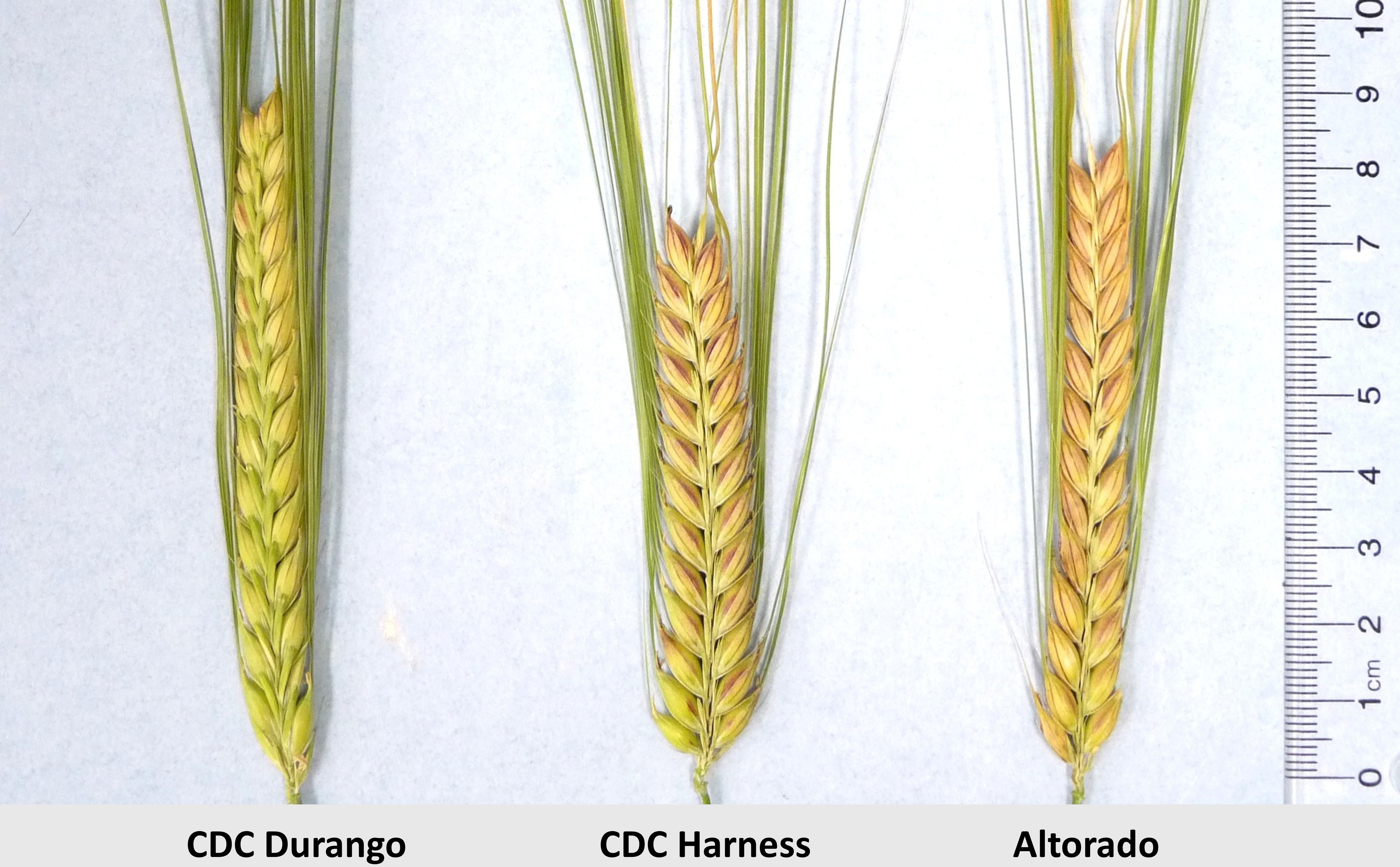
Barley: ‘CDC Harness' (centre) with reference varieties ‘CDC Durango' (left) and ‘Altorado' (right).
- Date modified: