
Fortuna
| Denomination: | 'Fortuna' |
|---|---|
| Previously Proposed Denomination: | '22-1' |
| Botanical Name: | Borago officinalis |
| Applicant/Holder: |
Bioriginal Food & Science Corp. 102 Melville Street Saskatoon, Saskatchewan S7J 0R1 Canada |
| Breeder: |
Guohai Wu, Bioriginal Food & Science Corp., Saskatoon, Saskatchewan |
| Application Date: | 2025-03-20 |
| Provisional Protection: | 2025-03-20 |
| Application Number: | 25-11982 |
Variety Description
Varieties used for comparison: '17-1', '22-2' and 'Vidal'
Summary: At the rosette stage, the lower leaf of ‘Fortuna' has a strong undulation of the margin while the lower leaf of '17-1' has a weak undulation of the margin. The lower leaf of ‘Fortuna' is shorter than the lower leaf of '17-1' and 'Vidal'. The lower leaf of ‘Fortuna' is narrower than the lower leaf of '17-1'. The lower leaf of ‘Fortuna' is medium in size while the lower leaf of '17-1' is large. The plants of ‘Fortuna' flower later than the plants of '17-1' and 'Vidal'. On freshly opened flowers, the petal of ‘Fortuna' is white while the petals on the flowers of ‘22-2' are blue and for '17-1', 75% of the flowers have blue petals and 25% of the flowers have white petals. The anthocyanin colouration on the pedicel of ‘Fortuna' is of a weak intensity while that of ‘22-2' is of a strong intensity. The anthocyanin colouration on the sepal of ‘Fortuna' is of a weak to medium intensity while that of ‘22-2' is of a strong intensity. After flowering, the plants of ‘Fortuna' are shorter than the plants of '17-1' and taller than those of '22-2'. The plants of ‘Fortuna' mature later than the plants of the reference varieties.
Description:
PLANT: open pollinated spring borage, medium vigor, mid-season bolting and flowering, medium height after flowering, indeterminate flowering, matures mid-season
LOWER LEAF (AT ROSETTE STAGE): medium sized, short to medium length, medium width, medium length/width ratio
LOWER LEAF BLADE (AT ROSETTE STAGE): strong undulation of margin, medium green, pointed tip, medium to dense pubescence on upper side, medium degree of blistering on upper side
LOWER LEAF PETIOLE: semi-erect attitude
UPPER LEAF (AFTER BOLTING): small, medium length, narrow to medium width, medium length/width ratio
UPPER LEAF BLADE (AFTER BOLTING): weak to medium undulation of margin, medium green, pointed tip, dense pubescence on upper side, medium to high degree of blistering on upper side
STEM: low extent of weak intensity anthocyanin colouration, anthocyanin colouration absent at leaf axil
INFLORESCENCE: scorpioid cyme type, weak intensity of anthocyanin colouration on pedicel
FLOWER: white petal, petal spacing is overlapping
SEPAL: weak to medium intensity of anthocyanin colouration
SEED: dark brown, reticulate seed coat
CHEMICAL REACTION: tolerant to imidazolinone herbicides
Origin & Breeding History: ‘Fortuna' (experimental designations 19-10 & 22-1) originated from the cross conducted in a green house between the borage lines 15-411-1 and 187-1 at Bioriginal Food and Science Corp. in Saskatoon, Saskatchewan in 2017. The variety was advanced in winter nurseries in Chile and in Saskatchewan where an F6 line was designated 19-10 in 2019 based on shattering resistance, herbicide tolerance, gamma-linolenic acid (GLA) content in the seed oil, seed yield along with other agronomic traits. After the line was further multiplied in Chile, it was assessed for yield by Integrated Crop Management Services (ICMS) in Saskatchewan, Manitoba and Alberta from 2020-2023. The line was concurrently assessed for gamma-linolenic acid (GLA) content in the seed oil and designated 22-1 in 2022. Breeder seed production commenced in Portage la Prairie, Manitoba in 2024.
Tests & Trials: The comparative trials for ‘Fortuna' were conducted at AgQuest Inc. in Saskatoon, Saskatchewan during the 2024 and 2025 growing seasons. The trial consisted of 4 replicates in an RCB design. Each plot consisted of 5 rows, 5 meters long with a row spacing of 20 cm. The planting density resulted in a minimum of 800 plants per variety. Measured characteristics were based on 20 measurements per variety per year. Mean differences were significant at the 5% probability level based on a paired Student's t-test. The trials were sprayed post emergence with Imazamox, at an application rate of approximately 8.13g/acre, with no plant injury observed.
Comparison table for 'Fortuna' with reference varieties '17-1', '22-2' and 'Vidal'
Lower leaf length (cm)
| 'Fortuna' | '17-1' | '22-2' | 'Vidal' | |
|---|---|---|---|---|
| mean 2024 | 12.8 | 15.8 | 12.4 | 13.8 |
| std. deviation 2024 | 0.80 | 1.23 | 1.42 | 1.12 |
| mean 2025 | 13.4 | 18.1 | 13.6 | 16.2 |
| std. deviation 2025 | 1.08 | 1.80 | 2.05 | 2.35 |
Lower leaf width (cm)
| 'Fortuna' | '17-1' | '22-2' | 'Vidal' | |
|---|---|---|---|---|
| mean 2024 | 8.4 | 10.0 | 8.4 | 8.4 |
| std. deviation 2024 | 0.53 | 0.92 | 0.86 | 0.70 |
| mean 2025 | 6.7 | 8.2 | 6.8 | 7.5 |
| std. deviation 2025 | 0.81 | 0.80 | 1.03 | 0.99 |
Days to flowering (days from sowing to when the first flower is open on 50% of the plants)
| 'Fortuna' | '17-1' | '22-2' | 'Vidal' | |
|---|---|---|---|---|
| mean 2024 | 48 | 45 | 49 | 46 |
| mean 2025 | 56 | 52 | 55 | 54 |
Plant height (after flowering)
| 'Fortuna' | '17-1' | '22-2' | 'Vidal' | |
|---|---|---|---|---|
| mean 2024 | 58.5 | 68.3 | 54.8 | 62.7 |
| std. deviation 2024 | 4.01 | 7.29 | 6.46 | 4.21 |
| mean 2025 | 60.0 | 74.3 | 55.4 | 61.6 |
| std. deviation 2025 | 3.82 | 6.72 | 4.07 | 4.71 |
Days to maturity (days from sowing to when seed is dry and hard)
| 'Fortuna' | '17-1' | '22-2' | 'Vidal' | |
|---|---|---|---|---|
| mean 2024 | 118 | 115 | 115 | 115 |
| mean 2025 | 119 | 117 | 117 | 117 |
Click on image for larger view
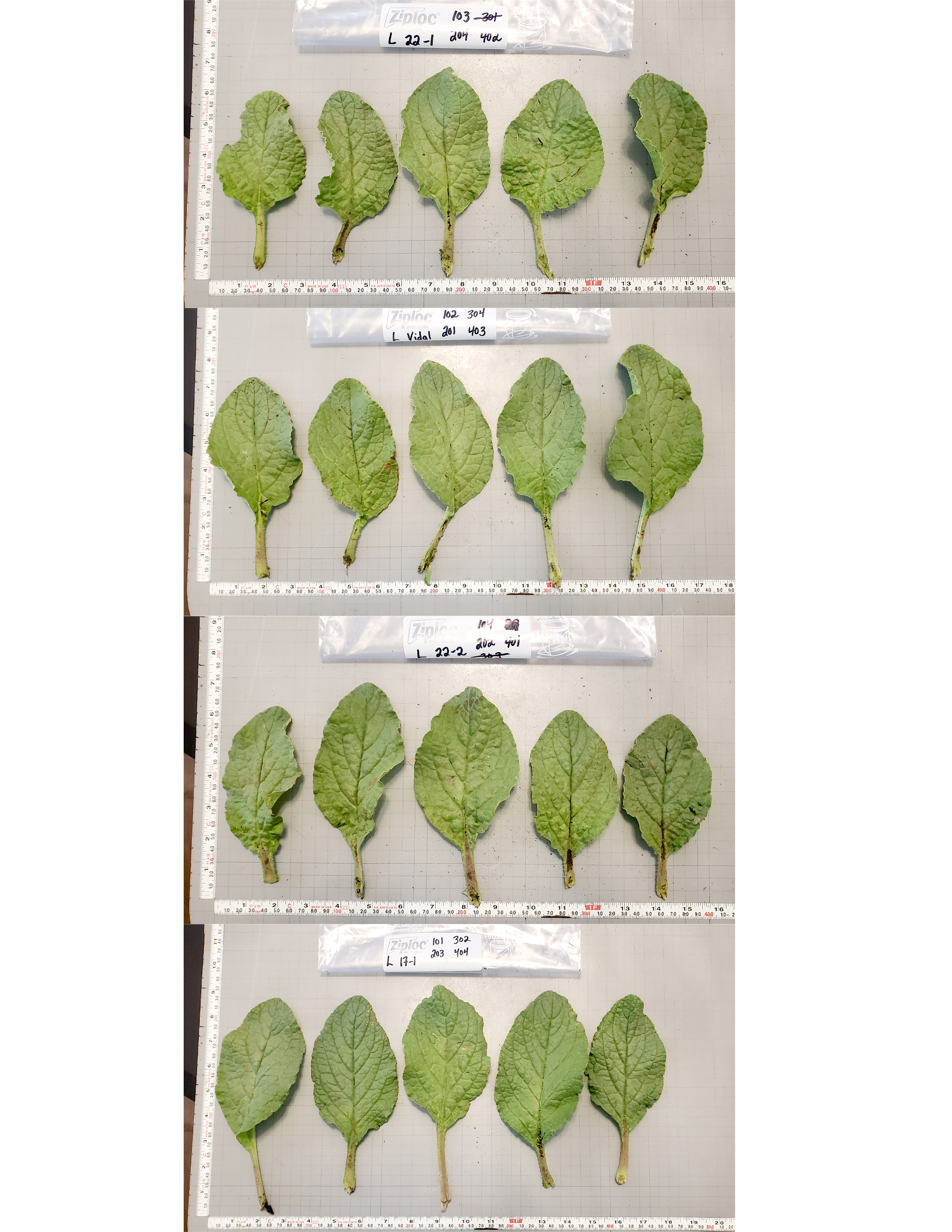
Borage: ‘Fortuna' (top) with reference varieties ‘Vidal' (deuxième à partir du haut), '22-2' (2nd from bottom) and '17-1' (bottom)
Click on image for larger view
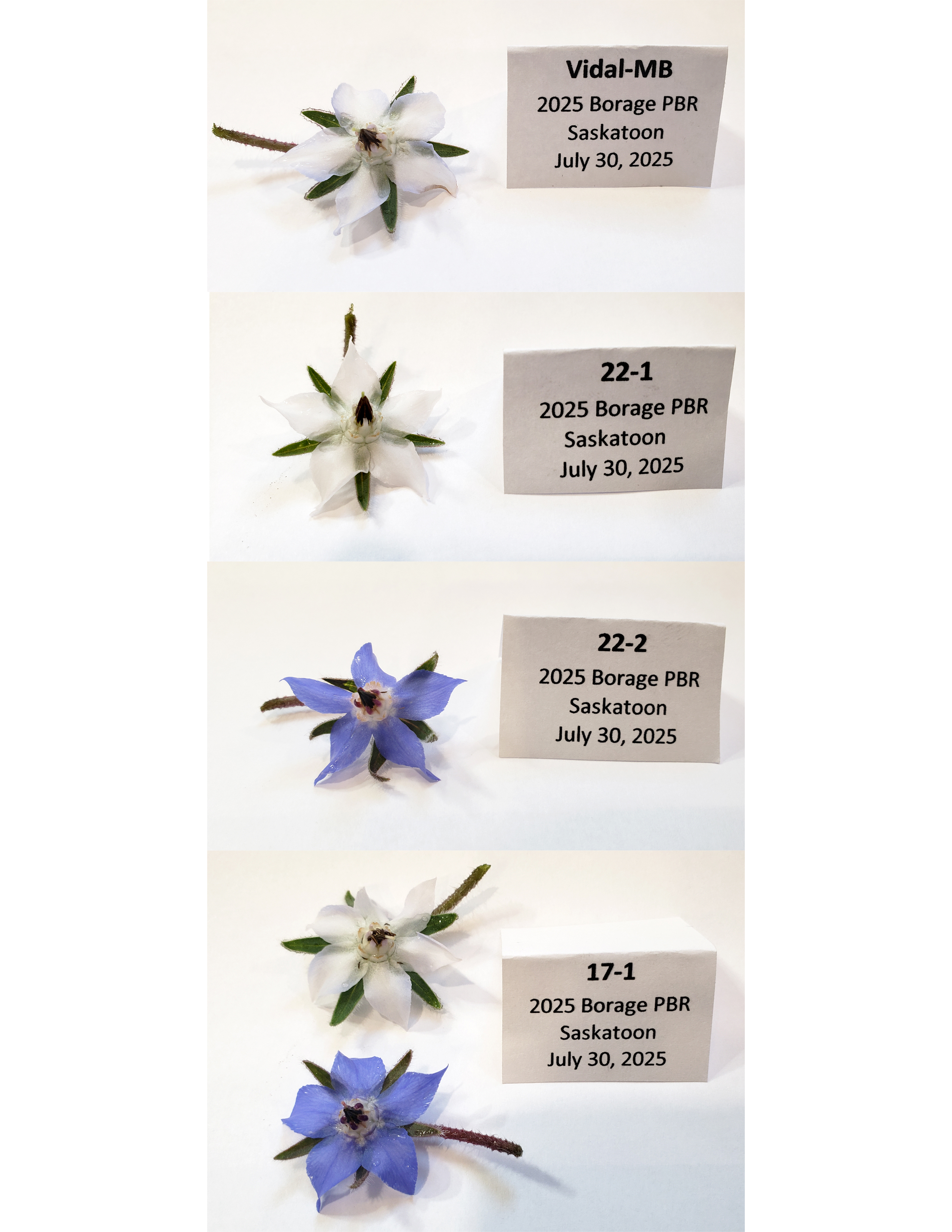
Borage: ‘Fortuna' (2nd from top) with reference varieties ‘Vidal' (top), '22-2' (2nd from bottom) and '17-1' (bottom)
- Date modified: