
4PMKK84R
| Denomination: | '4PMKK84R' |
|---|---|
| Botanical Name: | Brassica napus |
| Applicant/Holder: |
Pioneer Hi-Bred International, Inc. 8305 NW, 62nd Avenue P.O. Box 7060 Johnston, Iowa 50131 United States of America |
| Breeder: |
Scott McClinchey, Pioneer Hi-Bred Production Company, Caledon, Ontario |
| Agent in Canada: |
Pioneer Hi-Bred Production Company Site 600 PO Box 12, RR#6 3Km N on Hwy 41 on Llewellyn Road Saskatoon, Saskatchewan S7K 3J9 Canada Tel: 306-203-4895 |
| Application Date: | 2020-05-14 |
| Provisional Protection: | 2020-05-14 |
| Application Number: | 20-10226 |
Variety Description
Variety used for comparison: 'NS6569MC'
Summary: The leaf margin of ‘4PMKK84R' is rounded whereas the leaf margin of ‘NS6569MC' is undulating. ‘4PMKK84R' has a shorter silique than ‘NS6569MC'.
Description:
PLANT male fertile inbred line, open pollinated spring type, tall at maturity
COTYLEDON: medium width
LEAF: medium green, very few to few lobes, rounded margin, shallow margin indentations, medium length, narrow to medium width, short to medium length petiole
FLOWER PETAL: yellow, not touching to touching petal spacing
ANTHER: pollen production present
SILIQUE: semi-erect attitude, short, medium to wide, medium length beak, short to medium length pedicel
Origin & Breeding History: ‘4PMKK84R' is a restorer inbred line developed by Pioneer Hi-Bred International, Inc. using a double haploid plant breeding method. The variety originated from a cross between two proprietary inbred lines conducted in Georgetown, Ontario, Canada in 2011. Both parental inbred lines carried the Ogura and Ogu-INRA cytoplasmic male sterility restorer genes in a homozygous state. The resulting F1 generation was subject to the double haploidization process with one line selected and designated as ‘4PMKK84R' in 2014 based on plant vigour, time of flowering and pod development, glucosinolate levels, saturated fats, and oil content. Breeder seed production commenced in 2019.
Tests & Trials: The comparative trials for ‘4PMKK84R' were conducted during the 2022 and 2023 growing seasons in Saskatoon, Saskatchewan. The trial included 3 replicates. The candidate and reference variety were sown side by side in the first replicate whereas varieties in the second and third replicate were completely randomized. The plots consisted of 2 rows that were 3 metres in length with spacing of 50 cm between rows. The planting density of 26 seeds per metre resulted in a total of 468 plants per variety per year. The measured characteristics were based on 30 measurements per variety per year except for silique characteristics which were based on 60 measurements per variety per year. Mean differences were significant at the 2% probability level based on LSD values.
Comparison table for '4PMKK84R' with reference variety 'NS6569MC'
Silique length (mm)
| '4PMKK84R' | 'NS6569MC' | |
|---|---|---|
| mean 2022 (LSD=0.21) | 51.3 | 55.6 |
| std. deviation 2022 | 7.5 | 6.0 |
| mean 2023 (LSD=0.20) | 47.9 | 55.0 |
| std. deviation 2023 | 5.4 | 9.0 |
Click on image for larger view
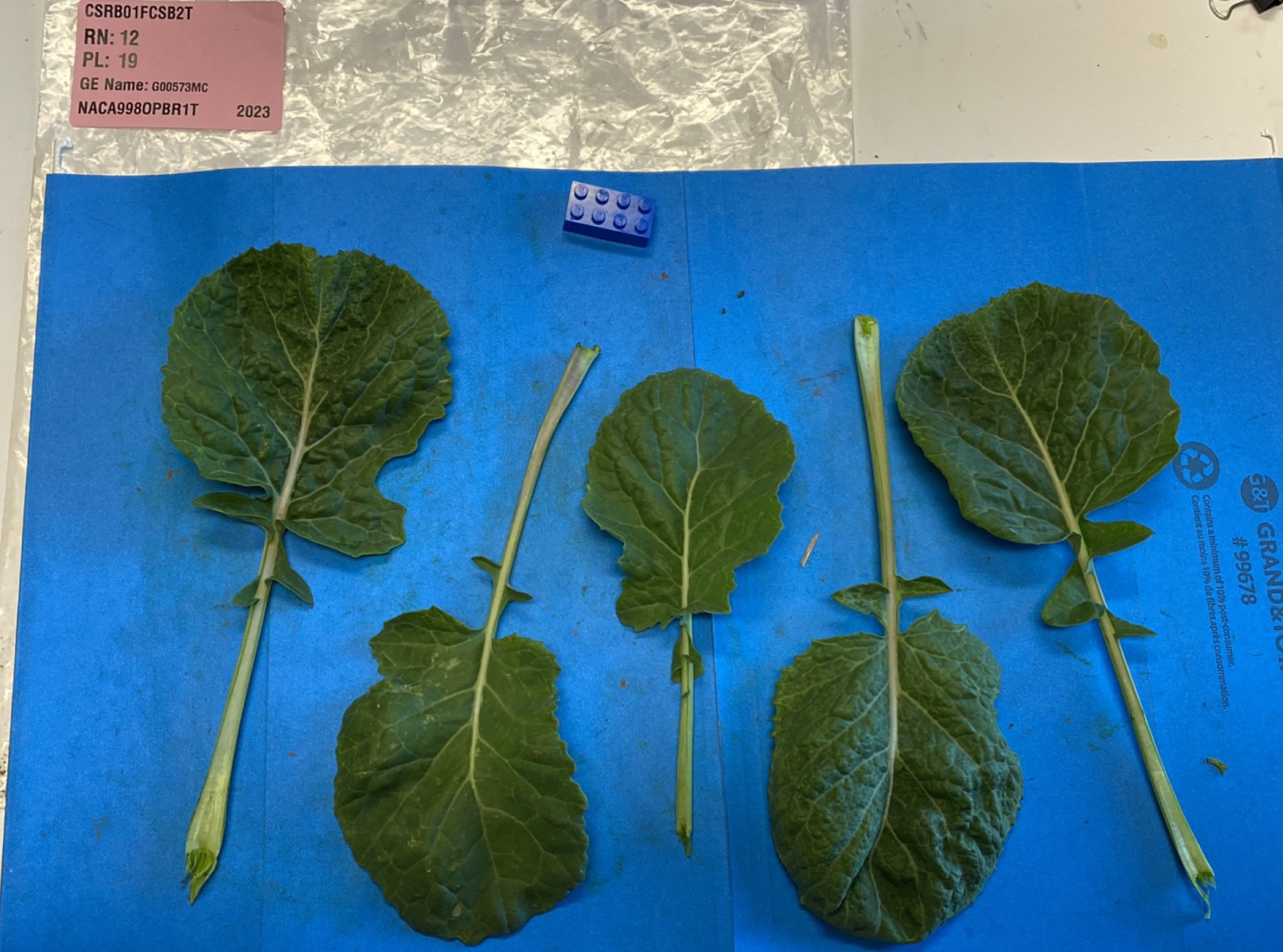
Canola: ‘4PMKK84R'
Click on image for larger view
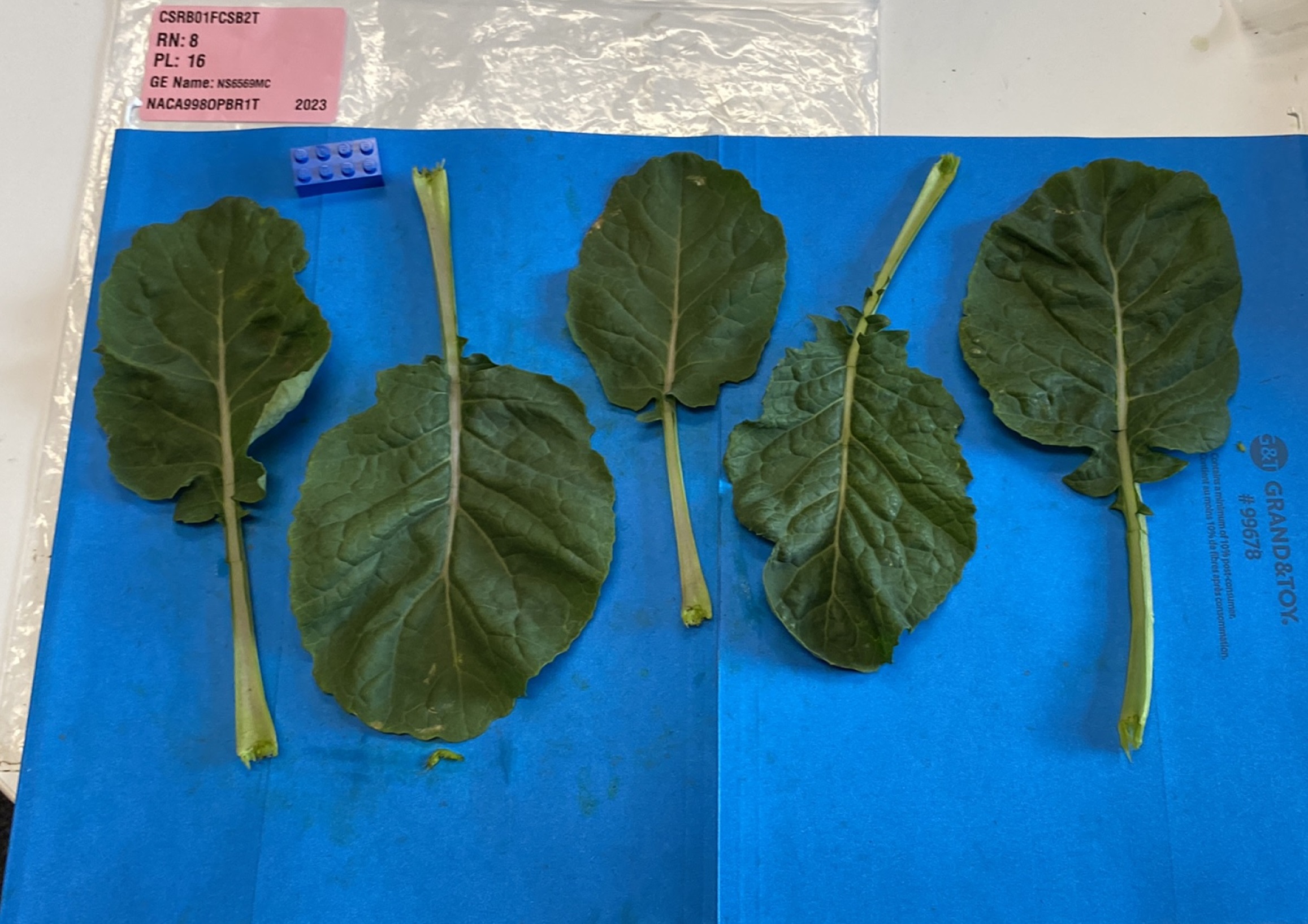
Canola: Reference variety ‘NS6569MC'
- Date modified: