
PR22CN859
| Denomination: | 'PR22CN859' |
|---|---|
| Botanical Name: | Brassica napus |
| Applicant/Holder: |
BASF Agricultural Solutions US LLC 2 T.W. Alexander Drive Research Triangle Park, North Carolina 27713-2847 United States of America |
| Breeder: |
Jeffrey Mansiere, BASF Agricultural Solutions Canada Inc., Saskatoon, Saskatchewan |
| Agent in Canada: |
BASF Agricultural Solutions Canada Inc. Site 600, Box 117 RR#6 Saskatoon, Saskatchewan S7K 3J9 Canada Tel: 306-371-6226 |
| Application Date: | 2023-07-04 |
| Provisional Protection: | 2023-07-04 |
| Application Number: | 23-11428 |
| Grant of Rights Date: | 2025-11-10 |
| Certificate Number: | 7524 |
| Exemption from compulsory licensing: | Yes |
| Expiry date for exemption from compulsory licensing: | 2027-11-10 |
| Grant of Rights Termination Date: | 2045-11-10 |
Note: The applicant has requested an exemption from compulsory licensing to allow time to multiply and distribute propagating material of the variety. If the exemption is granted, it may be allowed for two years from the date rights are granted for the variety.
Variety Description
Varieties used for comparison: 'PPS02-364', 'PPS04-205' and '5440'
Summary: The cotyledon of ‘PR22CN859' is shorter than that of ‘PPS02-364' and it is shorter and narrower than that of ‘5440'. ‘PR22CN859' has a longer leaf and petiole than ‘PPS02-364'. Flowering occurs later for the plants of ‘PR22CN859' than for those of the reference varieties. ‘PR22CN859' has a longer silique beak than ‘5440'. The pedicel of ‘PR22CN859' is longer than those of ‘PPS02-364' and ‘5440'. Plant maturity occurs later for ‘PR22CN859' than for the reference varieties. At maturity, the plants of ‘PR22CN859' are taller than those of the reference varieties.
Description:
PLANT: male fertile inbred line, spring type, tall at maturity
COTYLEDON: short to medium, narrow to medium width
LEAF: medium green, medium number of lobes, rounded margin, low to medium density of shallow margin indentations, medium length, narrow to medium width, short to medium petiole
FLOWER PETAL: yellow, medium length and width
SILIQUE: semi-erect to horizontal attitude, short to medium length, medium length beak, short to medium length pedicel
SEED COAT: black
AGRONOMIC CHARACTERISTICS: good resistance to lodging, good resistance to shattering
QUALITY CHARACTERISTICS: erucic acid is 0.03% of total fatty acids, oil content is 43.4% of whole dried seed, protein is 48.6% of dried oil free meal, low concentration of glucosinolates (12.4 µmol/g)
CHEMICAL REACTION: resistant to glufosinate ammonium herbicides
DISEASE REACTIONS: resistant to Blackleg (Leptosphaeria maculans asexual stage: Phoma lingam); resistant to Clubroot (Plasmodiophora brassicae)
Origin & Breeding History: ‘PR22CN859' is a restorer line in the process of F1 hybrid production. It was derived as a double haploid line containing the Rf3 gene in a homozygous state. The cross between proprietary lines was made in Saskatoon, Saskatchewan, Canada in 2019 and the subsequent double haploid line extraction was made from the resulting F1 in 2020. ‘PR22CN859' was selected in 2021 on the basis of fertility restoration of numerous male sterile lines and expression of resistance to glufosinate-ammonium herbicide. Other selection parameters included height, vigour, maturity, blackleg resistance, clubroot resistance, seed pod shattering resistance, oil content, fatty acid profile, glucosinolate content and combining ability. Breeder seed production commenced in Saskatoon, Saskatchewan, Canada in 2022.
Tests & Trials: The comparative trials for ‘PR22CN859' were conducted during the 2022 and 2023 growing seasons in Saskatoon, Saskatchewan. Trials were arranged in a RCB design with 3 replications per variety. The plots consisted of 3 rows that were 6 metres in length with spacing of 25 cm between rows and 50 cm between plots. The planting density resulted in a total of approximately 1300 plants per variety per year. The measured characteristics were based on 30 measurements except for silique characteristics which were based on 60 measurements. The means were based on a two-year average. Mean differences were significant at the 2% probability level based on LSD values.
Comparison tables for 'PR22CN859' with reference varieties 'PPS02-364', 'PPS04-205' and '5440'
Cotyledon length (mm)
| 'PR22CN859' | 'PPS02-364' | 'PPS04-205' | '5440' | |
|---|---|---|---|---|
| mean (LSD=1.3) | 11.3 | 13.0 | 12.7 | 13.6 |
| std. deviation | 1.3 | 1.4 | 1.1 | 2.0 |
Cotyledon width (mm)
| 'PR22CN859' | 'PPS02-364' | 'PPS04-205' | '5440' | |
|---|---|---|---|---|
| mean (LSD=1.0) | 20.5 | 22.8 | 21.7 | 25.9 |
| std. deviation | 1.4 | 2.7 | 1.8 | 2.1 |
Leaf length (cm)
| 'PR22CN859' | 'PPS02-364' | 'PPS04-205' | '5440' | |
|---|---|---|---|---|
| mean (LSD=2.8) | 22.8 | 19.5 | 21.3 | 23.6 |
| std. deviation | 2.0 | 1.5 | 2.3 | 2.2 |
Petiole length (cm)
| 'PR22CN859' | 'PPS02-364' | 'PPS04-205' | '5440' | |
|---|---|---|---|---|
| mean (LSD=1.6) | 9.7 | 6.7 | 8.7 | 9.6 |
| std. deviation | 1.6 | 1.4 | 1.7 | 1.5 |
Days to flowering (number of days from planting to when 50% of plants have one or more open flowers)
| 'PR22CN859' | 'PPS02-364' | 'PPS04-205' | '5440' | |
|---|---|---|---|---|
| mean | 48 | 40 | 41 | 39 |
Beak length (mm)
| 'PR22CN859' | 'PPS02-364' | 'PPS04-205' | '5440' | |
|---|---|---|---|---|
| mean (LSD=1.8) | 11.6 | 11.3 | 9.9 | 9.4 |
| std. deviation | 1.8 | 1.7 | 1.5 | 1.7 |
Pedicel length (mm)
| 'PR22CN859' | 'PPS02-364' | 'PPS04-205' | '5440' | |
|---|---|---|---|---|
| mean (LSD=3.0) | 21.9 | 18.1 | 18.8 | 18.4 |
| std. deviation | 3.6 | 2.5 | 4.6 | 3.5 |
Days to maturity (number of days from planting to maturity)
| 'PR22CN859' | 'PPS02-364' | 'PPS04-205' | '5440' | |
|---|---|---|---|---|
| mean | 94 | 86 | 90 | 88 |
Plant height (at maturity) (cm)
| 'PR22CN859' | 'PPS02-364' | 'PPS04-205' | '5440' | |
|---|---|---|---|---|
| mean (LSD=8) | 143 | 125 | 117 | 130 |
| std. deviation | 9 | 13 | 13 | 14 |
Click on image for larger view
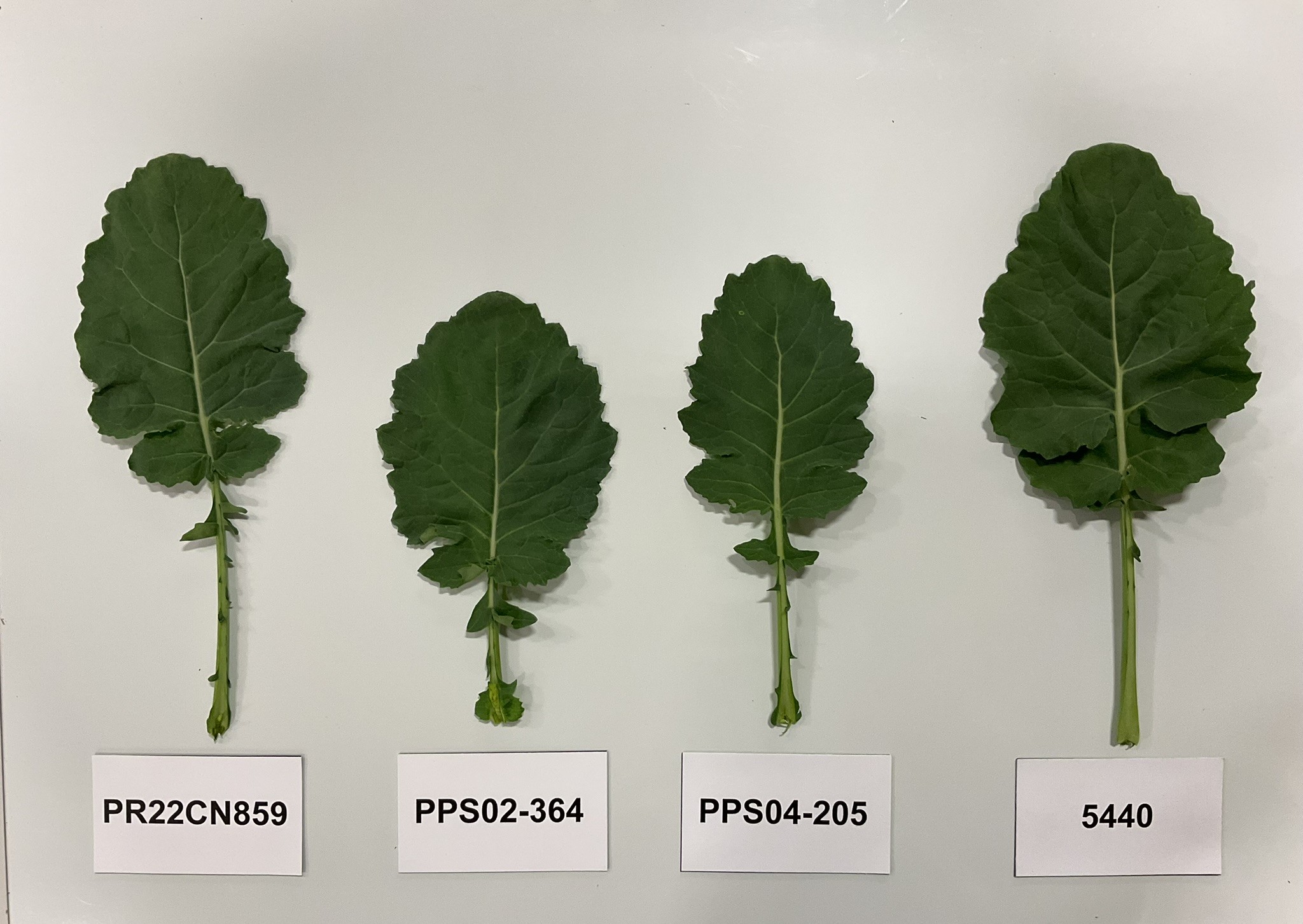
Canola: ‘PR22CN859' (left) with reference ‘PPS02-364' (centre left), ‘PPS04-205' (centre right) and ‘5440' (right)
- Date modified: