
Itasca
| Denomination: | 'Itasca' |
|---|---|
| Botanical Name: | Vitis |
| Applicant/Holder: |
Regents of the University of Minnesota 200 Oak Street 360 McNamara Alumni Center Minneapolis, Minnesota 55455-0400 United States of America |
| Breeder: |
James Luby, St. Paul, United States of America John Thull, Exelsior, United States of America Peter Hemstad, Edina, United States of America Kathryn Cook, Montour Falls, United States of America Nicolas Smith, Sauk City, United States of America |
| Agent in Canada: |
BioFlora Inc. 38723 Fingal Line R.R. #1 St. Thomas, Ontario N5P 3S5 Canada Tel: 519-317-7511 |
| Application Date: | 2018-01-26 |
| Provisional Protection: | 2018-01-26 |
| Application Number: | 18-9376 |
| Grant of Rights Date: | 2026-05-06 |
| Certificate Number: | 7699 |
| Grant of Rights Termination Date: | 2051-05-06 |
Variety Description
Varieties used for comparison: 'Frontenac Blanc' and 'La Crescent'
Summary: The mature leaf blade of ‘Itasca' is large whereas that of ‘La Crescent' is medium sized. The arrangement of the lobes of the petiole sinus on the mature leaf blade of ‘Itasca' is half open whereas that of ‘Frontenac Blanc' is wide open. The erect hairs on the main veins of the lower side of the mature leaf blade of ‘Itasca' range from medium to dense whereas those of ‘La Crescent' range from absent or very sparse to sparse. The peduncle of the bunch of ‘Itasca' has a weak to medium intensity of anthocyanin colouration whereas that of both reference varieties has a strong intensity of anthocyanin colouration. The bunch for ‘Itasca' is small whereas that of ‘Frontenac Blanc' is medium sized. The density of the bunch of ‘Itasca' ranges from medium to dense whereas that of ‘La Crescent' ranges from lax to medium. The peduncle of the primary bunch for ‘Itasca' is a short to medium length whereas that of ‘La Crescent' is medium to long.
Description:
YOUNG SHOOT TIP: wide open, absent or very weak intensity of anthocyanin colouration of prostrate hairs, absent or very sparse prostrate hairs, absent or very sparse erect hairs
WOODY SHOOT: reddish brown
SHOOT: semi-erect attitude (before tying), dorsal side of internodes is green and red, ventral side of internodes is green, dorsal side of nodes is green and red, ventral side of nodes is green, erect hairs on internodes range from sparse to medium density
TIME OF BEGINNING OF BUD BURST: early
YOUNG LEAF BLADE: green to green with anthocyanin specks on upper side, absent or very sparse prostrate hairs between main veins on lower side, medium density of erect hairs on main veins on lower side
MATURE LEAF BLADE: large, wedge shaped to circular shape, very weak blistering of upper side, three lobes, upper lateral sinuses range from shallow to medium depth, open arrangement of lobes of upper lateral sinuses, half open arrangement of lobes of petiole sinus, absent or very low proportion of anthocyanin colouration at base of main veins on upper side, absent or very sparse prostrate hairs between main veins on lower side, erect hairs on main veins on lower side range from medium to dense, petiole is moderately shorter than middle vein
MATURE LEAF TEETH: ranges from medium to long, medium length to width ratio, mixture of both sides straight and both sides convex shaped
FLOWER: fully developed stamens and gynoecium
PEDUNCLE: intensity of anthocyanin colouration ranging from weak to medium
BUNCH: small, ranges from medium to dense, short to medium length peduncle of primary bunch
BERRY: ranges from very small to small, globose shape, begins to ripen early, complete formation of seeds, moderately easy detachment from pedicel
BERRY SKIN: yellow green (without bloom), strong glaucosity, thin
BERRY FLESH: absent or very weak intensity of anthocyanin colouration, very firm, no particular flavour besides mildly sweet
Origin & Breeding History: ‘Itasca' originated from a controlled cross conducted between the female parent variety ‘Frontenac gris' and the male parent, a proprietary seedling designated as ‘MN12341', in Minnesota, USA in 2002. The new variety ‘Itasca' was selected in 2008, based on being adapted to specific growing conditions and location, suitability for wine production, fruit acidity, fruit sweetness, disease resistance characteristics and pest resistance characteristics. Asexual reproduction by hardwood stem cuttings was initiated in Excelsior, Minnesota, USA in 2009.
Tests & Trials: The comparative trial for ‘Itasca' was conducted outdoors during the summers of 2024 and 2025 at BioFlora, Inc. in St. Thomas, Ontario. The trial included 10 vines each of the candidate and reference varieties. All vines were transplanted from rooted cuttings into 11.4 litre containers in June of 2021. The vines were planted in the field with a spacing of 0.61m in October 2022. They were trellised on square fencing and pruned accordingly in the spring of 2023 and 2024. Observations and measurements were taken from 10 vines, or 10 parts of vines, of each variety in 2024 and 2025.
Click on image for larger view
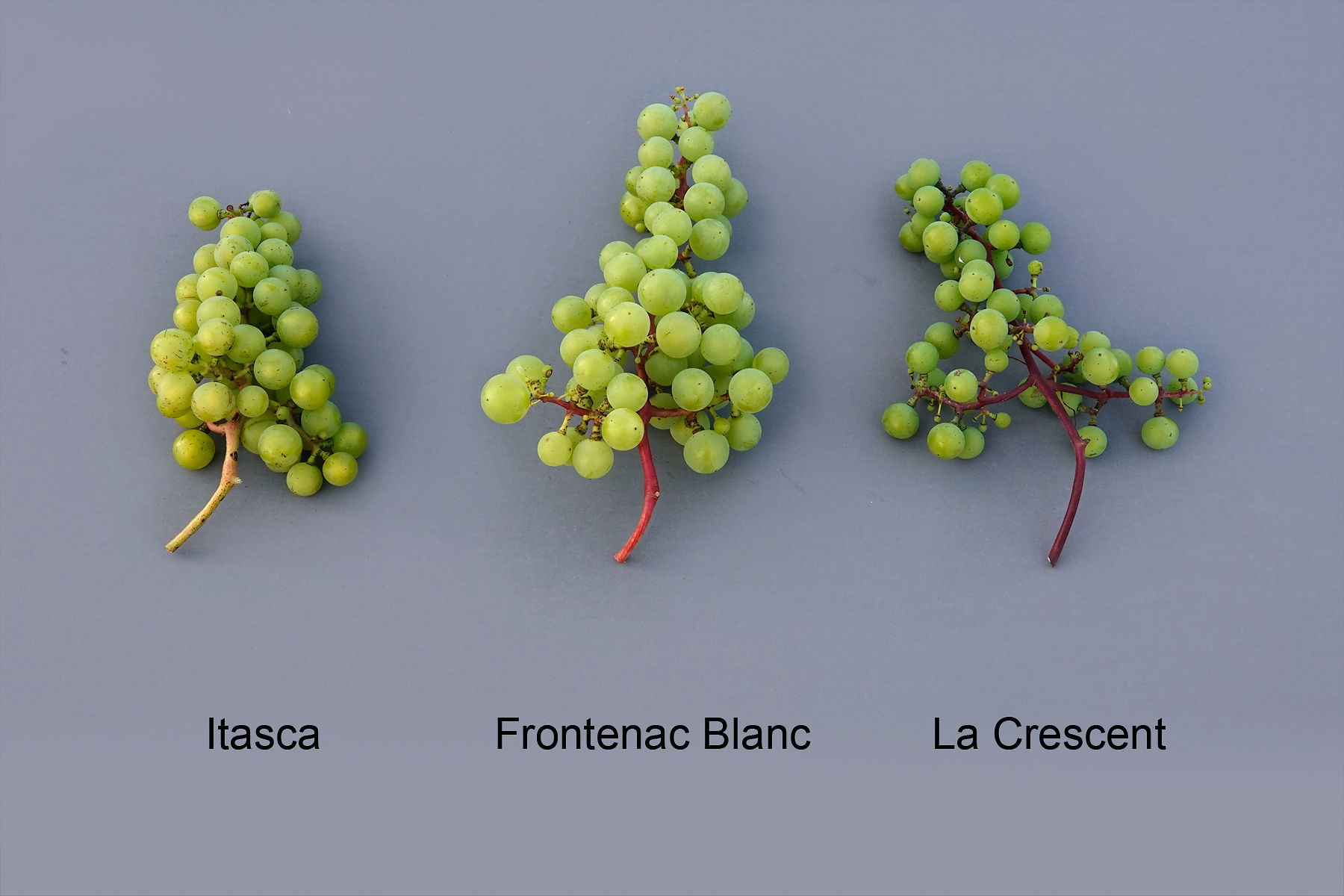
Grapevine: 'Itasca' (left) with reference varieties 'Fontenac Blanc' (center) and 'La Crescent' (right)
- Date modified: