
CDC Byer
| Denomination: | 'CDC Byer' |
|---|---|
| Botanical Name: | Avena sativa |
| Applicant/Holder: |
University of Saskatchewan Crop Development Centre 4D36 Agriculture Building, 51 Campus Drive Saskatoon, Saskatchewan S7N 5A8 Canada |
| Breeder: |
Aaron Beattie, University of Saskatchewan, Saskatoon, Saskatchewan |
| Application Date: | 2024-04-08 |
| Provisional Protection: | 2024-04-08 |
| Application Number: | 24-11644 |
| Grant of Rights Date: | 2026-04-21 |
| Certificate Number: | 7673 |
| Grant of Rights Termination Date: | 2046-04-21 |
Variety Description
Varieties used for comparison: 'CDC Arborg' and 'CDC Endure'
Summary: At booting, the frequency of ‘CDC Byer' plants with recurved flag leaves is low to medium whereas that of the reference varieties is medium to high. After heading at the green stage, the plants of ‘CDC Byer' are shorter than those of the reference varieties. The panicle of ‘CDC Byer' has a medium density while that of ‘CDC Arborg' is lax. The glume of ‘CDC Byer' has a weak glaucosity while that of the reference varieties is medium to strong. The panicle of ‘CDC Byer' is shorter than that of the reference varieties. At maturity, the pubescence of the rachilla of ‘CDC Byer' is sparse whereas it is absent to very sparse for ‘CDC Endure'. In the central third of the panicle, the lower glume of ‘CDC Byer' is shorter than that of ‘CDC Endure'. The lemma of ‘CDC Byer' has an absent to very low tendency to be awned while that of ‘CDC Arborg' has a weak to strong tendency. The hulled kernels of ‘CDC Byer' are lighter and shorter than those of the reference varieties.
Description:
PLANT: hulled spring type, semi-erect growth habit at 5 to 9 tiller stage, low to medium frequency of plants with recurved flag leaves at booting
STEM: absent to very sparse pubescence above and below upper culm node
LOWER LEAF: absent to very sparse pubescence on sheath and blade at the 5 to 9 tiller stage
LEAF (AT BOOTING): dark green, absent to very sparse pubescence on margin of leaf below flag leaf, medium glaucosity at green stage
PANICLE (SHORTLY AFTER HEADING): equilateral/symmetrical orientation of branches, medium density, semi-erect attitude of branches, ranging between less than 30 degree and 30 to 45 degree angle between rachis and dominant side branches, few short hairs or spines on the lower node
SPIKELET: nodding, ranging between two and two to three grains, fracture separation
RACHILLA: medium to long length between primary and secondary floret, medium to long grooves
GLUME: weak glaucosity
LEMMA: white at maturity, weak glaucosity, absent or very sparse pubescence on lateral and dorsal surface, absent to very weak tendency to be awned, medium overlap on palea
GROAT: medium density of pubescence
KERNEL: cream, ranging between short to medium and medium basal hairs
SCUTELLUM: pointed tip, medium size
AGRONOMIC CHARACTERISTICS: fair to good lodging resistance
Origin & Breeding History: ‘CDC Byer' (experimental designation ‘OT3115' and ‘SA172419') originated from a cross conducted under a glass greenhouse between ‘OT3073' and ‘OT3076' at the Crop Development Centre, University of Saskatchewan in Saskatoon, Saskatchewan in the winter of 2012/2013. It was developed using a modified bulk breeding system. Early generations were grown as bulk populations in Saskatoon, Saskatchewan and Leeston, New Zealand. Individual panicles were selected in the F5 and F6 generations based on general seed characteristics. ‘SA172419' was selected in the F6 generation and tested in yield trials between 2017 – 2019 and Western Cooperative Oat registration trials as OT3115 during 2020-2021. Selection criteria included grain yield and quality characteristics. Breeder seed was created in the F12 generation in 2022.
Tests & Trials: The comparative trials for ‘CDC Byer' were conducted at Crop Development Centre, University of Saskatchewan in Saskatoon, Saskatchewan in the 2023 and 2024 growing seasons. The trials were conducted using a RCB design consisting of 4 replications per variety. Each plot consisted of 5 rows spaced 20 cm apart, with a row length of 3.66 metres. The planting density of 215 plants per square metre resulted in approximately 5600 plants per variety per year. Measured characteristics were based on a minimum of 24 measurements per variety per year except kernel weight, which was based on 10 and 6 measurements of 1000 kernels per variety in 2023 and 2024, respectively. Mean differences were significant at the 5% probability level based on LSD values.
Comparison tables for 'CDC Byer' with reference varieties 'CDC Arborg' and 'CDC Endure'
Plant height (culm plus panicle at green stage) (cm)
| 'CDC Byer' | 'CDC Arborg' | 'CDC Endure' | |
|---|---|---|---|
| mean 2023 (LSD=1.8) | 92.2 | 104.7 | 100.7 |
| std. deviation 2023 | 4.7 | 5.4 | 5.1 |
| mean 2024 (LSD=2.1) | 105.3 | 119.1 | 115.5 |
| std. deviation 2024 | 3.7 | 4.1 | 3.8 |
Panicle length (at green stage) (cm)
| 'CDC Byer' | 'CDC Arborg' | 'CDC Endure' | |
|---|---|---|---|
| mean 2023 (LSD=0.6) | 16.5 | 19.7 | 18.1 |
| std. deviation 2023 | 1.1 | 1.7 | 1.3 |
| mean 2024 (LSD=1.0) | 17.0 | 20.7 | 19.2 |
| std. deviation 2024 | 1.3 | 1.8 | 1.8 |
Lower glume length (mm)
| 'CDC Byer' | 'CDC Arborg' | 'CDC Endure' | |
|---|---|---|---|
| mean 2023 (LSD=0.5) | 19.3 | 20.6 | 21.3 |
| std. deviation 2023 | 1.0 | 0.9 | 0.8 |
| mean 2024 (LSD=0.5) | 20.3 | 20.8 | 21.2 |
| std. deviation 2024 | 0.7 | 0.7 | 0.9 |
Hulled kernel weight (grams per 1000 kernels)
| 'CDC Byer' | 'CDC Arborg' | 'CDC Endure' | |
|---|---|---|---|
| mean 2023 (LSD=0.4) | 36.1 | 39.2 | 38.1 |
| std. deviation 2023 | 0.4 | 0.4 | 0.6 |
| mean 2024 (LSD=0.4) | 26.1 | 29.4 | 29.4 |
| std. deviation 2024 | 0.5 | 0.2 | 0.3 |
Hulled kernel length (primary grain) (mm)
| 'CDC Byer' | 'CDC Arborg' | 'CDC Endure' | |
|---|---|---|---|
| mean 2023 (LSD=0.4) | 10.7 | 11.8 | 11.7 |
| std. deviation 2023 | 0.5 | 0.5 | 0.7 |
| mean 2024 (LSD=0.4) | 11.2 | 12.0 | 11.7 |
| std. deviation 2024 | 0.6 | 0.6 | 0.5 |
Click on image for larger view
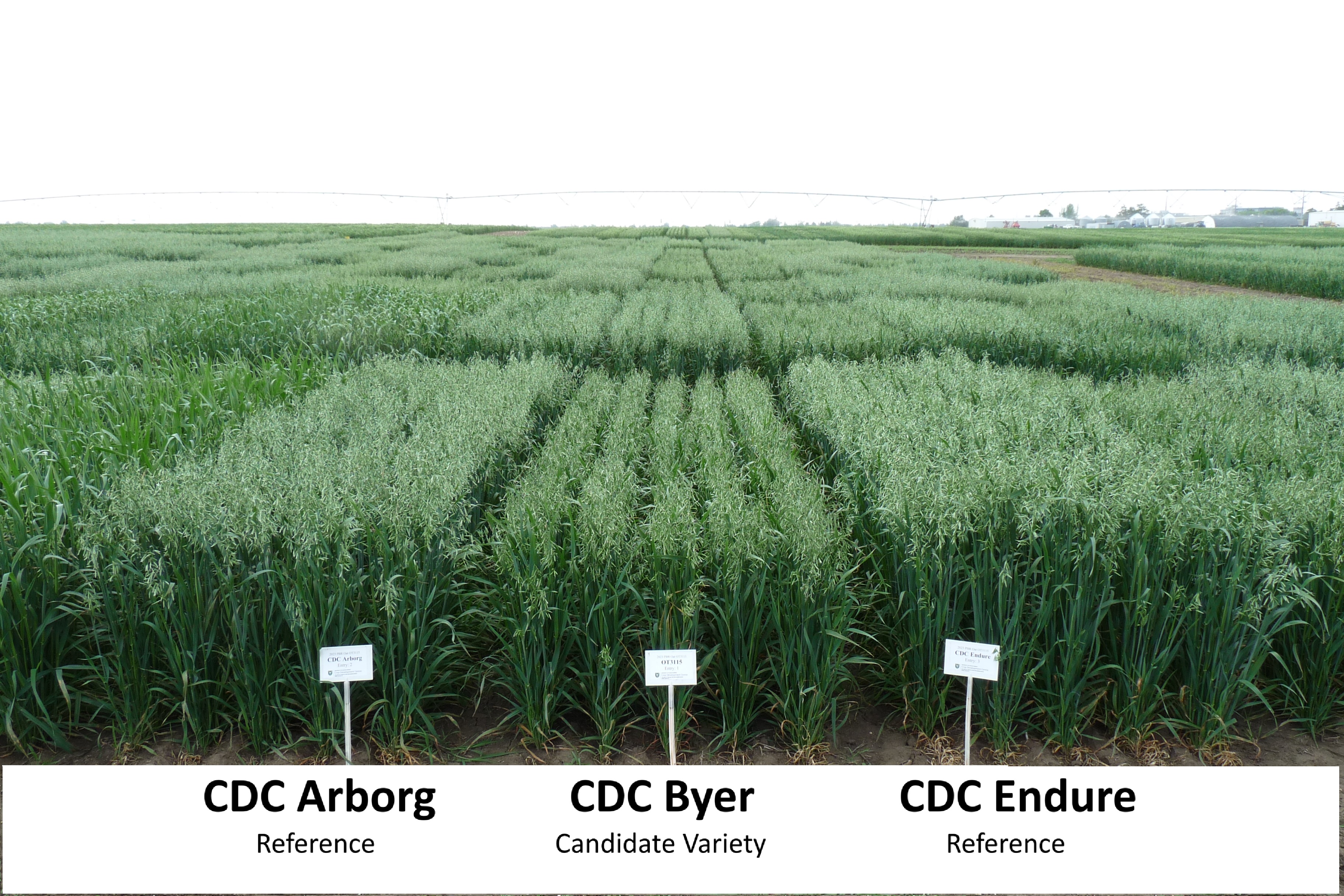
Oat: 'CDC Byer' (centre) with reference varieties 'CDC Arborg' (left) and 'CDC Endure' (right)
Click on image for larger view
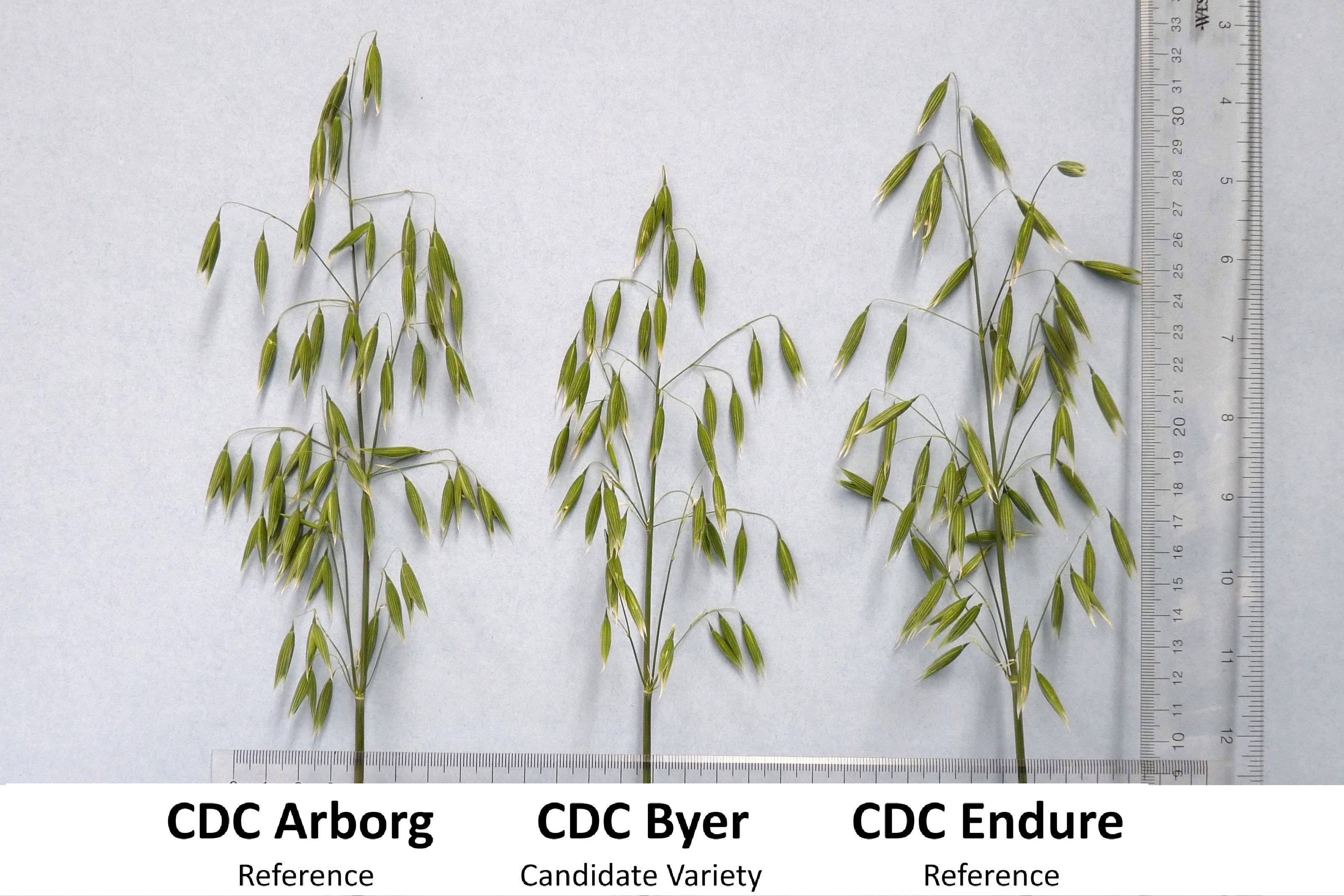
Oat: 'CDC Byer' (centre) with reference varieties 'CDC Arborg' (left) and 'CDC Endure' (right)
- Date modified: