
Caphorn
| Denomination: | 'Caphorn' |
|---|---|
| Botanical Name: | Pisum sativum |
| Applicant/Holder: |
RAGT 2n SAS Rue Emile Singla - Site de Bourran BP3361 Rodez Cedex 9 12000 France |
| Breeder: |
RAGT2n SAS, Rodez, France |
| Agent in Canada: |
DL Seeds Inc. 25028 Road 17N Stanley, Manitoba R6P 0G9 Canada Tel: 204-331-3611 ext. 3223 |
| Application Date: | 2023-05-23 |
| Provisional Protection: | 2023-05-23 |
| Application Number: | 23-11381 |
| Grant of Rights Date: | 2026-04-29 |
| Certificate Number: | 7696 |
| Grant of Rights Termination Date: | 2046-04-29 |
Variety Description
Variety used for comparison: 'CDC Amarillo'
Summary: From the axil to the first tendril, the petiole of ‘Caphorn' is longer than the petiole of ‘CDC Amarillo'. The pod of ‘Caphorn' is longer than that of ‘CDC Amarillo'. The shape of the distal part of the pod of ‘Caphorn' is blunt whereas that of ‘CDC Amarillo' is pointed.
Description:
PLANT: field type, anthocyanin colouration absent, medium intensity of green foliage at flowering, flowers mid-season
STEM: anthocyanin colouration of axil absent, fasciation absent, medium to many nodes up to and including the first fertile node
LEAF: leaflets absent
STIPULE: medium size, medium length from axil to tip, medium to long lobe below axil, sparse density of flecking
PEDUNCLE: short spur, absent or few bracts
FLOWER: maximum of two per node
STANDARD: white, moderately arched base
UPPER SEPAL: medium to broad, acute apex
POD: absent or partial parchment, no thickened wall, blunt shape of distal part, absent or very weak curvature, medium green when fully swollen, suture strings absent
IMMATURE SEED: medium green intensity
DRY SEED: ellipsoid, simple starch grains, yellow cotyledon, matures mid-season
HILUM: same colour as testa
Origin & Breeding History: ‘Caphorn' (experimental designations LRP1814 and DL1814) originated from the cross between the lines 10L06 and SR5149 conducted in 2011 at the breeding station of RAGT 2n in Louville, France. Following five self-pollination generations, a single F6 row was selected in 2016 based on its standability, plant length, disease tolerance, insect tolerance and maturity time. It was multiplied and tested in several environments to assess seed yield, thousand kernel weight and protein content and purified from the F7 to F9 generations. Breeder seed was established after the F10 generation in 2019.
Tests & Trials: The comparative trials for ‘Caphorn' were conducted at the DL Seeds Research Station in Morden, Manitoba during the 2022 and 2023 growing seasons. The trials were arranged in a RCB design consisting of 3 replications per variety. Each replicate consisted of 6 rows spaced 23 cm apart, with a row length of 4 metres and a planting density of 80 seeds per square metre. The measured characteristics were based on 100 measurements per variety per year except for the 100 seed weight where 3 measurements were taken per variety per year. Mean differences were significant at the 5% confidence probability level based on a paired Student's t-test.
Comparison tables for 'Caphorn' with reference variety 'CDC Amarillo'
Petiole length (from axil to the first tendril) (cm)
| 'Caphorn' | 'CDC Amarillo' | |
|---|---|---|
| mean 2022 | 7.70 | 7.27 |
| std. deviation 2022 | 1.56 | 1.13 |
| mean 2023 | 10.15 | 9.05 |
| std. deviation 2023 | 1.85 | 1.42 |
Pod length (at second fertile node) (cm)
| 'Caphorn' | 'CDC Amarillo' | |
|---|---|---|
| mean 2022 | 6.76 | 5.78 |
| std. deviation 2022 | 1.06 | 0.73 |
| mean 2023 | 7.27 | 6.18 |
| std. deviation 2023 | 0.70 | 0.57 |
Click on image for larger view
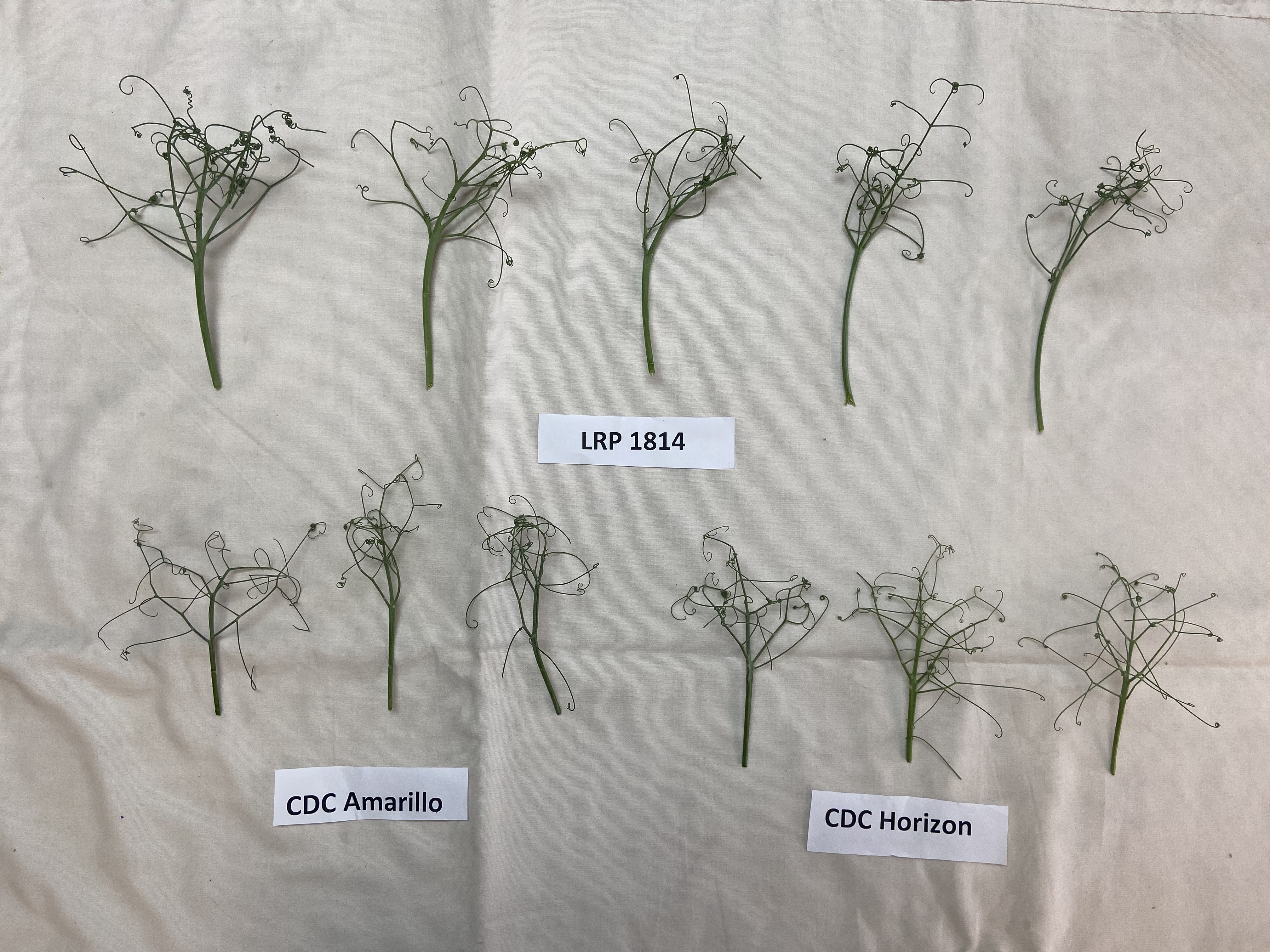
Pea: 'Caphorn' (top) with reference variety 'CDC Amarillo' (bottom left)
Click on image for larger view
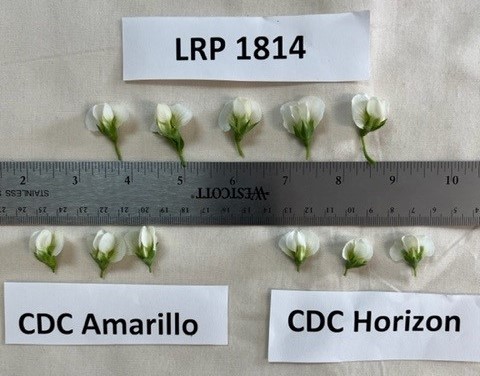
Pea: 'Caphorn' (top) with reference variety 'CDC Amarillo' (bottom left)
Click on image for larger view
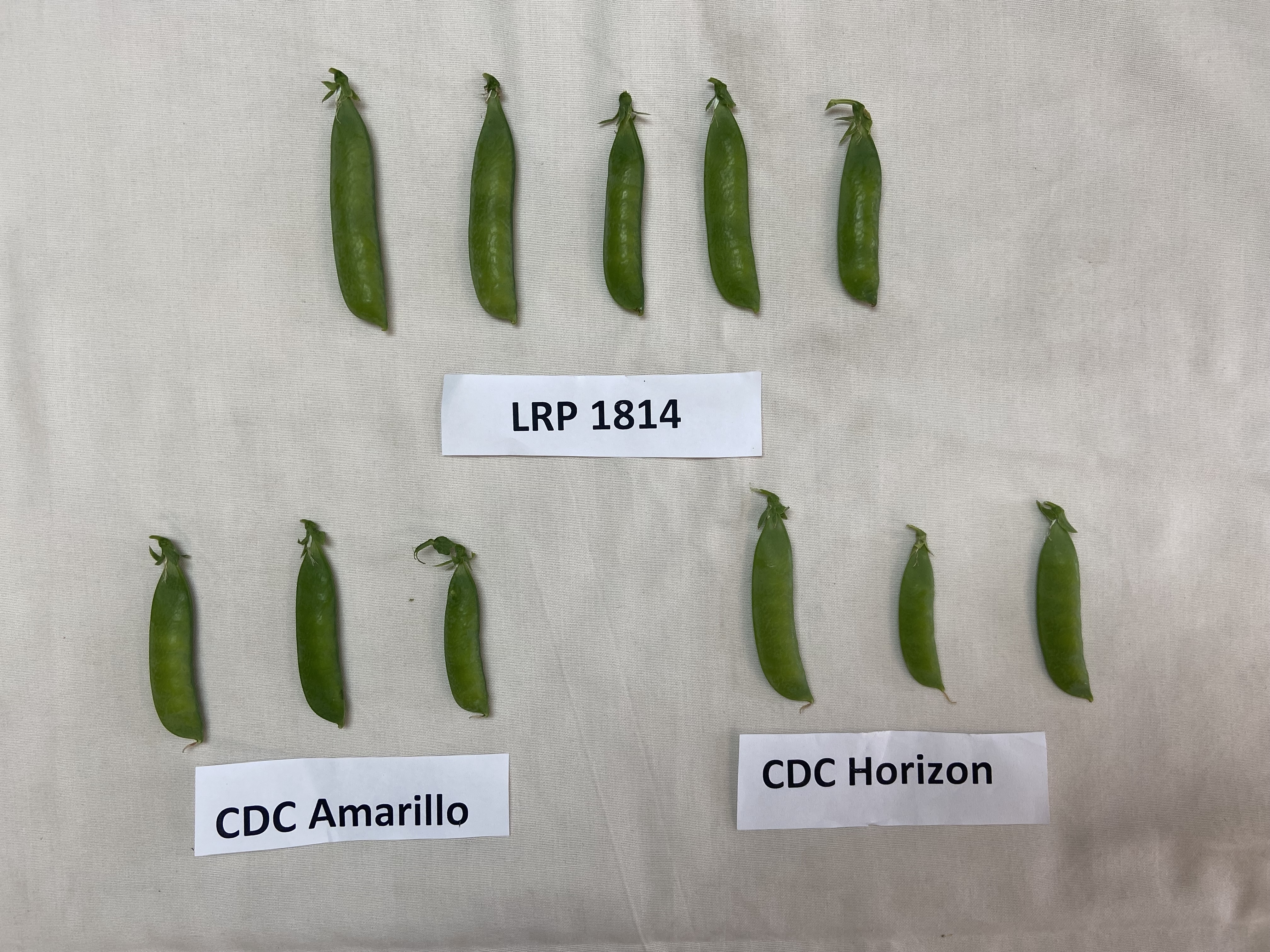
Pea: 'Caphorn' (top) with reference variety 'CDC Amarillo' (bottom left)
- Date modified: