
Tilbury
| Denomination: | 'Tilbury' |
|---|---|
| Botanical Name: | Solanum tuberosum |
| Applicant/Holder: |
Germicopa Breeding Allée Loeiz Herrieu, 1 29334 Cedex Quimper France |
| Breeder: |
Germicopa Breeding, Quimper, France |
| Agent in Canada: |
Lavery, De Billy, S.E.N.C.R.L. - LLP 1 Place Ville Marie, Suite 4000 Montreal, Quebec H3B 4M4 Canada Tel: 514 397-5138 |
| Application Date: | 2022-01-10 |
| Provisional Protection: | 2022-01-10 |
| Application Number: | 22-10773 |
| Grant of Rights Date: | 2026-02-04 |
| Certificate Number: | 7631 |
| Grant of Rights Termination Date: | 2046-02-04 |
Variety Description
Variety used for comparison: 'Atlantic'
Summary: The lightsprout of ‘Tilbury' has very few to few root tips and short lateral roots while that of ‘Atlantic' has a medium number of root tips and very short lateral roots. The base of the lightsprout of ‘Tilbury' has a sparse to medium density of pubescence while that of ‘Atlantic' has medium to dense pubescence. The lightsprout apex of ‘Tilbury' has an intermediate habit, medium intensity of anthocyanin colouration, and medium to dense pubescence while that of ‘Atlantic' has a closed habit, very weak to weak intensity of anthocyanin colouration, and sparse pubescence. The plants of ‘Tilbury' have an upright growth habit while those of ‘Atlantic' have a semi-upright growth habit. The plants of ‘Tilbury' are shorter than those of ‘Atlantic'. The plants of ‘Tilbury' mature late in the season while those of ‘Atlantic' mature mid-season. The leaf of ‘Tilbury' has a free arrangement of leaflets while that of ‘Atlantic' has a touching arrangement of leaflets. The flower bud of ‘Tilbury' has a weak intensity of anthocyanin colouration while that of ‘Atlantic' has a strong intensity of anthocyanin colouration. The corolla of ‘Tilbury' has a medium diameter while that of ‘Atlantic' has a large diameter.
Description:
LIGHTSPROUT: medium size, very few to few root tips, short lateral shoots
LIGHTSPROUT BASE: ovoid, strong intensity of anthocyanin colouration, medium proportion of blue in anthocyanin colouration, sparse to medium density of pubescence
LIGHTSPROUT APEX: medium size in relation to base, intermediate habit, medium intensity of anthocyanin colouration, medium to dense pubescence
PLANT: foliage structure is intermediate type where foliage is half open and stems are partly visible, upright growth habit, medium number of inflorescences, matures late in the season
STEM: low extent of anthocyanin colouration
LEAF: small to medium size, free arrangement of leaflets, few to medium number of secondary leaflets, light to medium green upper side, absent or very weak intensity of anthocyanin colouration on upper side of midrib
SECOND PAIR OF LATERAL LEAFLETS: narrow to medium width in relation to length
TERMINAL AND LATERAL LEAFLETS: absent or very low frequency of coalescence
INFLORESCENCE: small to medium size
PEDUNCLE: absent or very low to low extent of anthocyanin colouration
FLOWER BUD: weak intensity of anthocyanin colouration
COROLLA: medium diameter
COROLLA (INNER SIDE): high extent of anthocyanin colouration, medium intensity of anthocyanin colouration, absent or low proportion of blue in anthocyanin colouration
TUBER: round to short-oval, yellowish white flesh
TUBER EYE: medium depth, yellow at base
TUBER SKIN: light yellow brown, medium texture
Origin & Breeding History: 'Tilbury' (experimental designation G06TT376008) originated from the cross between ‘Gunda' and 'Jenny' conducted at the Germicopa breeding station in Châteauneuf-du-Faou, France in 2005. Lines were advanced from 2006 to 2009 based on visual impression. One line was designated ‘G06TT376008' in 2006. The variety was further assessed from 2010 to 2012 based on pest resistance, yield, processing quality, storability, and visual impression, and designated ‘Tilbury' in 2010.
Tests & Trials: The comparative trial for 'Tilbury' was conducted by Global Agri Services Inc. in Central Blissville, New Brunswick during the 2024 growing season. The field trial consisted of a single 14.86 metre long row, per variety. Rows were spaced 1.1 metres apart with each row containing 65 plants spaced 0.23 metres apart. Measurements were taken from 10 plants, or 10 parts of plants, of each variety. The mean difference was significant at the 5% probability level based on a paired Student's t-test. Lightsprout characteristics were assessed on 10 tubers harvested from the comparative trial and observed approximately 2.5 to 3 months after sprouting was promoted by exposing the tubers to an external agent.
Comparison table for 'Tilbury' with reference variety 'Atlantic'
Plant height (cm)
| 'Tilbury' | 'Atlantic' | |
|---|---|---|
| mean | 42.3 | 49.8 |
| std. deviation | 2.7 | 3.7 |
Click on image for larger view
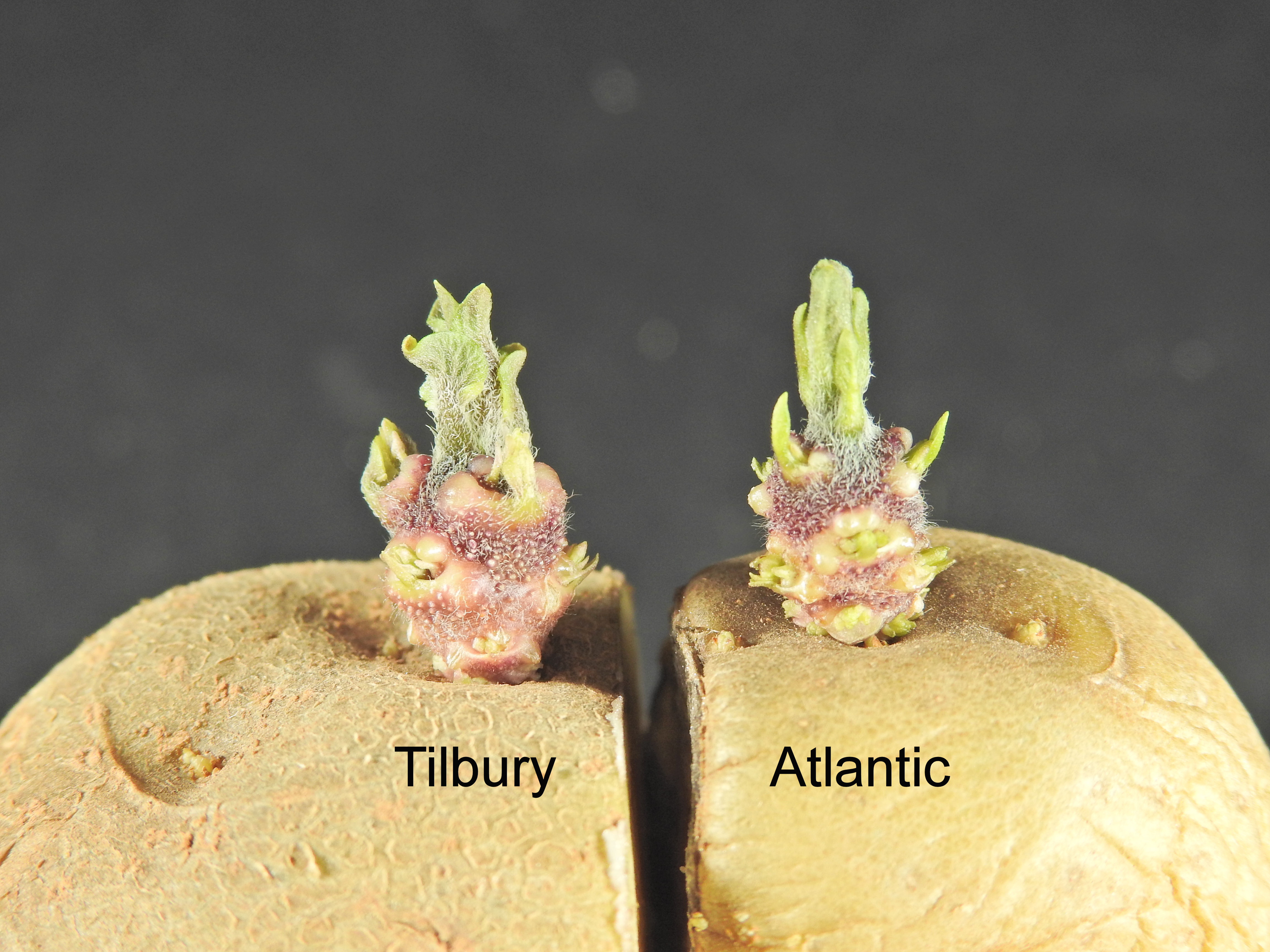
Potato: ‘Tilbury' (left) with reference variety ‘Atlantic' (right)
- Date modified: