
OAC Kamran
| Denomination: | 'OAC Kamran' |
|---|---|
| Previously Proposed Denomination: | '17-16C-SCN' |
| Botanical Name: | Glycine max |
| Applicant/Holder: |
University of Guelph Germplasm Research Innovation Office Building #92, 50 Stone Road East Guelph, Ontario N1G 2W1 Canada |
| Breeder: |
Istvan Rajcan, University of Guelph, Guelph, Ontario |
| Application Date: | 2021-02-16 |
| Provisional Protection: | 2021-02-16 |
| Application Number: | 21-10440 |
| Grant of Rights Date: | 2025-11-13 |
| Certificate Number: | 7529 |
| Grant of Rights Termination Date: | 2045-11-13 |
Variety Description
Varieties used for comparison: 'OAC Acclaim' and 'OAC Evolution'
Summary: When 95% of the pods are ripe, the plants of ‘OAC Kamran' are shorter than those of ‘OAC Evolution'. The pod of ‘OAC Kamran' is longer than those of both reference varieties. The pod of ‘OAC Kamran' is narrower than that of ‘OAC Acclaim'.
Description:
HYPOCOTYL: anthocyanin colouration present
PLANT: indeterminate growth type, tawny pubescence on middle third of main stem, begins flowering mid to late season, matures early
LEAF: medium green upper side
TERMINAL LEAFLET: ovoid, small to medium size
LATERAL LEAFLET: pointed ovate, small to medium size
FLOWER: violet
POD: light brown
SEED: medium sized, spherical flattened, weak glaucosity, yellow ground colour of testa, opaque testa
HILUM: imperfect yellow, funicle same colour as testa
Origin & Breeding History: ‘OAC Kamran' (experimental designation ‘SeCan 17-16C-SCN') was developed at the University of Guelph in Guelph, Ontario using a single seed descent breeding method. The variety originated from a cross between the parent ‘S23-T5' and parent ‘DH530' conducted in 2012. The variety was advanced from the F1 to the F4 generation where a single plant was selected based on maturity and agronomic traits in 2013. The variety was designated ‘SeCan 17-16C-SCN' and tested in multiple trials from 2017 to 2019 in Ontario and Quebec.
Tests & Trials: The comparative trials of ‘OAC Kamran' were conducted in St. Thomas, Ontario during the 2022 and 2023 growing seasons. The trial included 3 replicates per variety arranged in an RCB design. Each plot consisted of a 9.14 meter row with approximately 300 plants per variety per year. Measured characteristics were based on 20 measurements per variety per year. Mean differences were significant at the 5% confidence probability level based on a paired Student's t-test.
Comparison tables for 'OAC Kamran' with reference varieties 'OAC Acclaim' and 'OAC Evolution'
Plant height (when 95% of the pods are ripe) (cm)
| 'OAC Kamran' | 'OAC Acclaim' | 'OAC Evolution' | |
|---|---|---|---|
| mean (2022) | 49.0 | 50.8 | 61.1 |
| std. deviation (2022) | 3.89 | 3.73 | 4.23 |
| mean (2023) | 39.5 | 39.9 | 45.1 |
| std. deviation (2023) | 4.62 | 8.17 | 5.24 |
Pod length (when 95% of the pods are ripe) (cm)
| 'OAC Kamran' | 'OAC Acclaim' | 'OAC Evolution' | |
|---|---|---|---|
| mean (2022) | 5.0 | 4.5 | 4.1 |
| std. deviation (2022) | 4.78 | 3.32 | 2.68 |
| mean (2023) | 5.2 | 4.4 | 4.2 |
| std. deviation (2023) | 0.36 | 0.14 | 0.16 |
Pod width (when 95% of the pods are ripe) (mm)
| 'OAC Kamran' | 'OAC Acclaim' | 'OAC Evolution' | |
|---|---|---|---|
| mean (2022) | 6.7 | 7.2 | 7.2 |
| std. deviation (2022) | 0.51 | 0.61 | 0.62 |
| mean (2023) | 7.11 | 7.57 | 7.36 |
| std. deviation (2023) | 0.45 | 0.41 | 0.46 |
Click on image for larger view
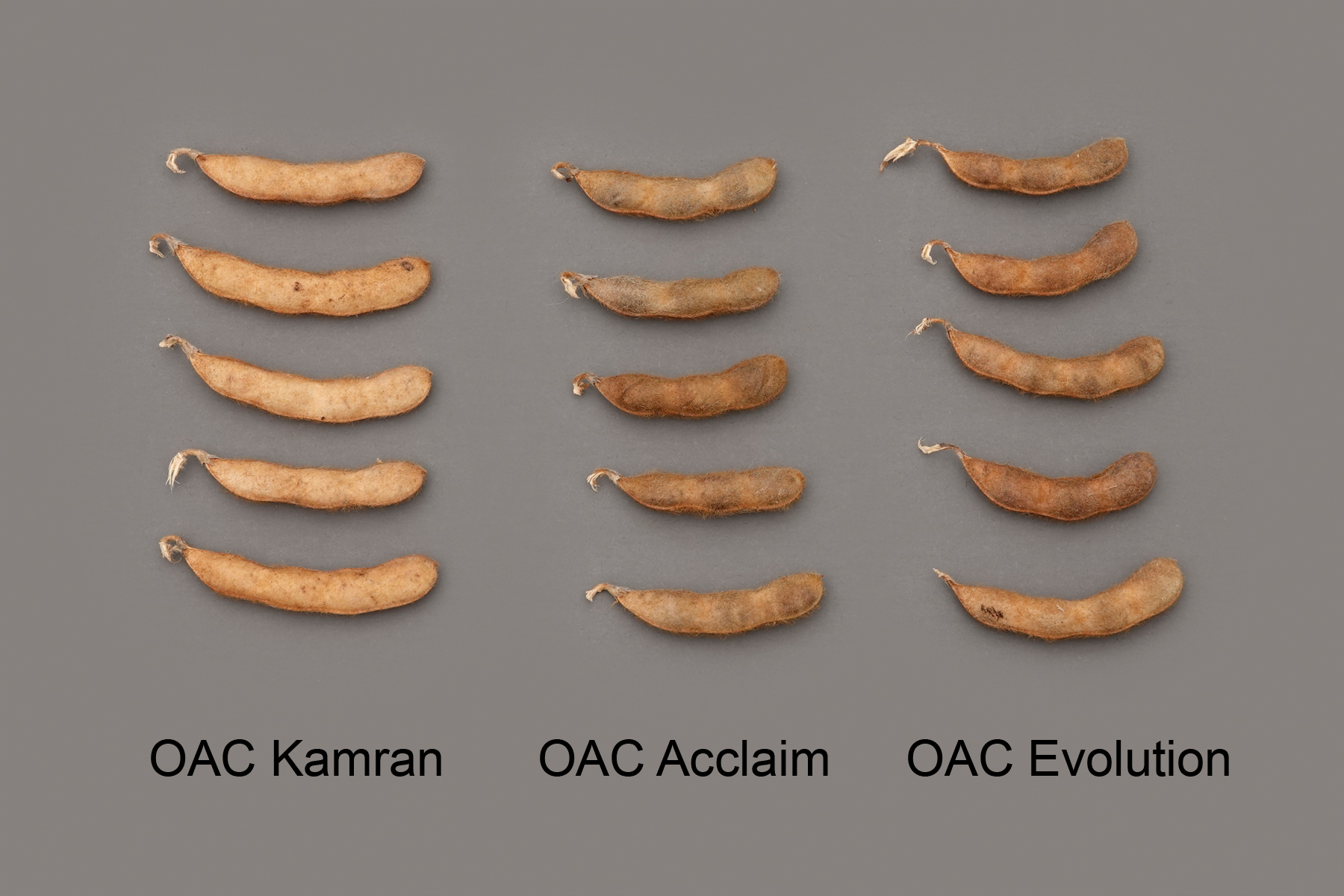
Soybean: 'OAC Kamran' (left) with reference varieties 'OAC Acclaim' (centre) and 'OAC Evolution' (right)
Click on image for larger view
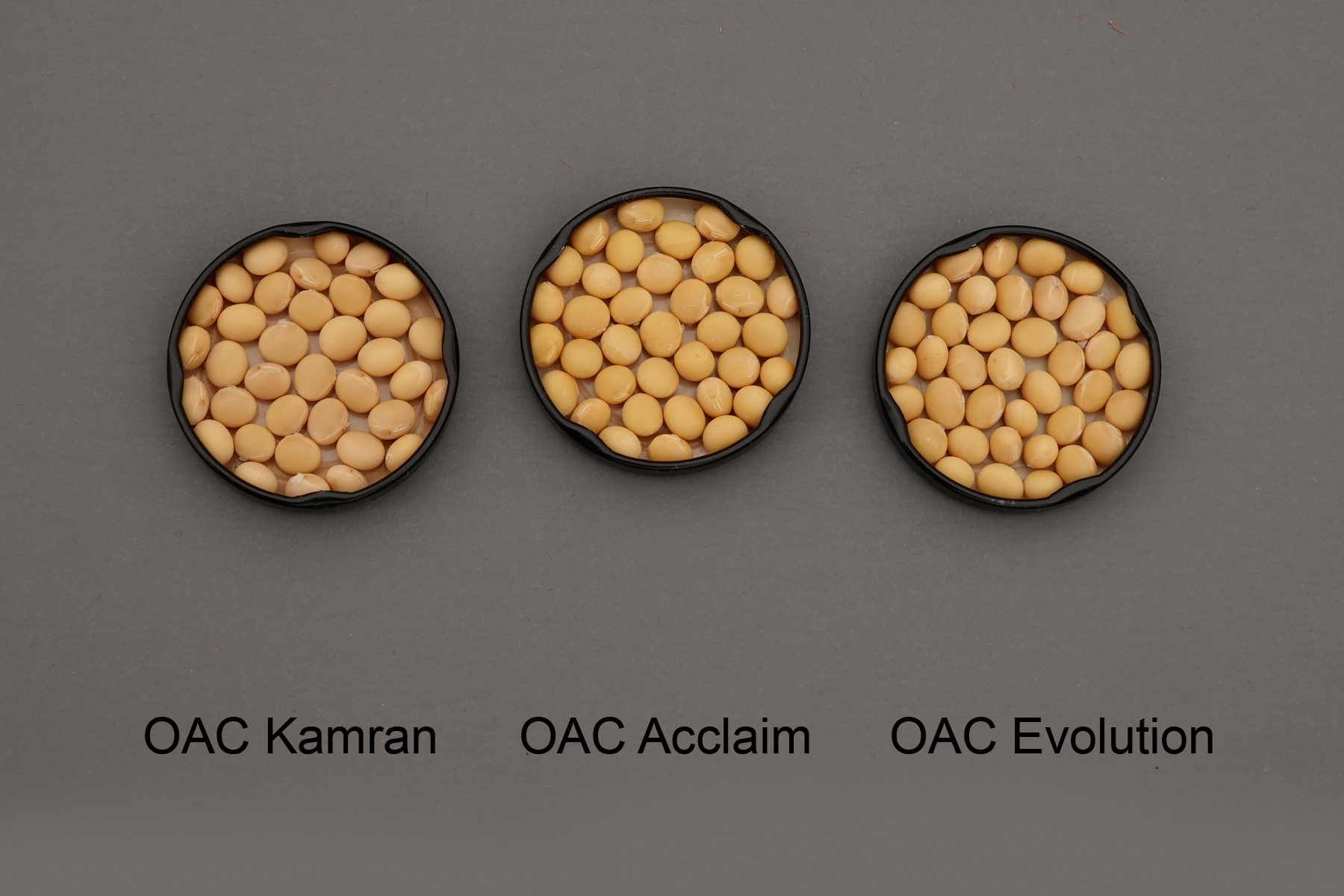
Soybean: 'OAC Kamran' (left) with reference varieties 'OAC Acclaim' (centre) and 'OAC Evolution' (right)
- Date modified: