
Wilma
| Denomination: | 'Wilma' |
|---|---|
| Botanical Name: | Glycine max |
| Applicant/Holder: |
Semences Prograin Inc. 145 bas de la Rivière Nord Saint-Césaire, Quebec J0L 1T0 Canada |
| Breeder: |
Sylvain Legay, Semences Prograin Inc., Saint-Césaire, Quebec |
| Application Date: | 2023-09-28 |
| Provisional Protection: | 2023-09-28 |
| Application Number: | 23-11495 |
| Grant of Rights Date: | 2025-11-05 |
| Certificate Number: | 7490 |
| Grant of Rights Termination Date: | 2045-11-05 |
Variety Description
Varieties used for comparison: 'Aya' and 'Genesis'
Summary: When 50% of the flowers are open, the branch attitude of 'Wilma' is erect to semi-erect whereas it is semi-erect for the reference varieties. From 50% flowering to when 95% of the pods are ripe, on the middle third of the main stem, the pubescence of 'Wilma' is light tawny whereas it is grey for the reference varieties. When 95% of the pods are ripe, the intensity of brown colour of the pod of 'Wilma' is light whereas it is medium for the reference varieties. At maturity, the one hundred seed weight for 'Wilma' is greater than that of 'Genesis'. The plants of 'Wilma' mature later than the plants of 'Aya'.
Description:
HYPOCOTYL: strong to very strong intensity of anthocyanin colouration
PLANT: indeterminate growth type, erect to semi-erect branch attitude, light tawny pubescence on middle third of main stem (pubescence appears grey at younger stages of development), begins flowering mid- to late season, matures mid-season
LEAF: medium sized pointed ovate lateral leaflet
FLOWER: violet
POD: light brown
SEED: medium size, spherical flattened, yellow ground colour of testa
HILUM: yellow
Origin & Breeding History: 'Wilma' (experimental designation PR140995Z-14) originated from a cross between the varieties 'OAC Calypso' and 'VIR 1238' conducted in 2014 in Saint-Césaire, Québec using the modified individual pedigree selection method of plant breeding. From 2015 to 2016, four generations were advanced between Rojas, Argentina and Saint-Césaire, Québec by single plant selection, line selection and yield testing. Selection criteria included yield, maturity, lodging resistance and disease resistance. 'Wilma' was selected at the F5 generation in 2016. Breeder seed was produced from F10 lines in 2021.
Tests & Trials: The comparative trials for 'Wilma' conducted in Saint-Césaire, Québec during the 2023 and 2024 growing seasons. Trials were planted in a RCB design and consisted of 2 replicates for each variety. Plots consisted of 2 rows, 5 metres in length and a row spacing of 76 cm. The trial consisted of 350 plants per variety. Measurements were taken from 20 plants or parts of 20 plants of each variety per year except for the seed weight with 10 measurements per variety per year. Mean differences were significant at the 5% probability level based on a Student's t-test.
Comparison tables for 'Wilma' with reference varieties 'Aya' and 'Genesis'
Seed weight (grams per 100 seeds) (g)
| 'Wilma' | 'Aya' | 'Genesis' | |
|---|---|---|---|
| mean 2023 | 25.3 | 25.3 | 23.0 |
| std. deviation 2023 | 0.34 | 0.33 | 0.31 |
| mean 2024 | 22.3 | 23.1 | 21.0 |
| std. deviation 2024 | 0.5 | 0.4 | 0.4 |
Number of days to maturity (from planting to maturity)
| 'Wilma' | 'Aya' | 'Genesis' | |
|---|---|---|---|
| 2023 | 130 | 127 | 131 |
| 2024 | 118 | 115 | 113 |
Click on image for larger view
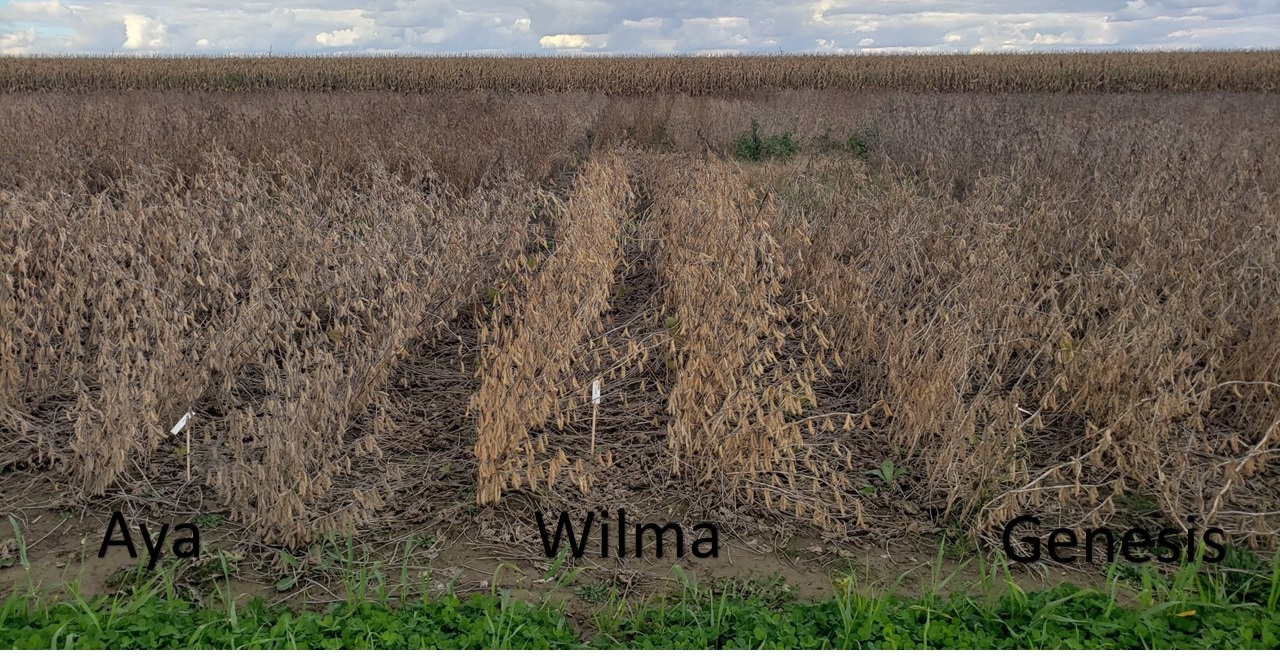
Soybean: 'Wilma' (centre) with reference varieties 'Aya' (left) and 'Genesis' (right)
Click on image for larger view
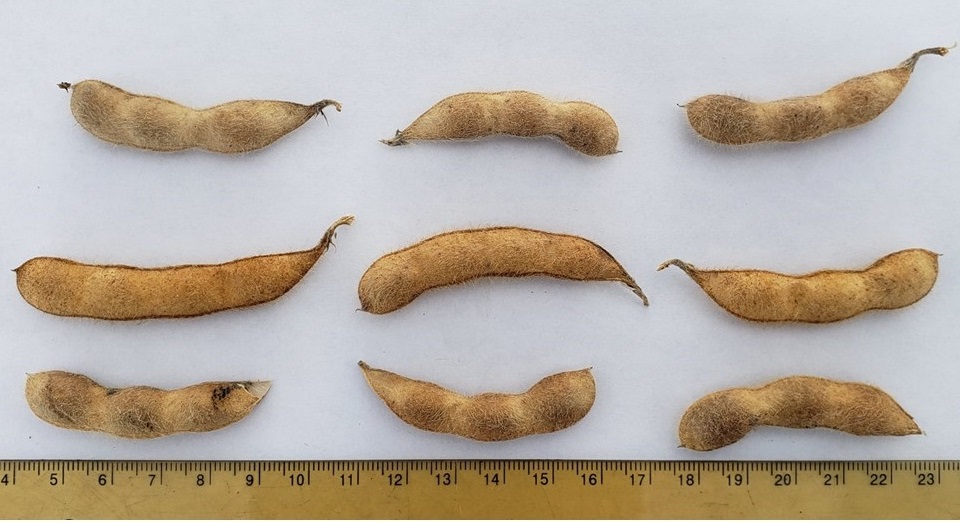
Soybean: 'Wilma' (centre) with reference varieties 'Aya' (top) and 'Genesis' (bottom)
Click on image for larger view
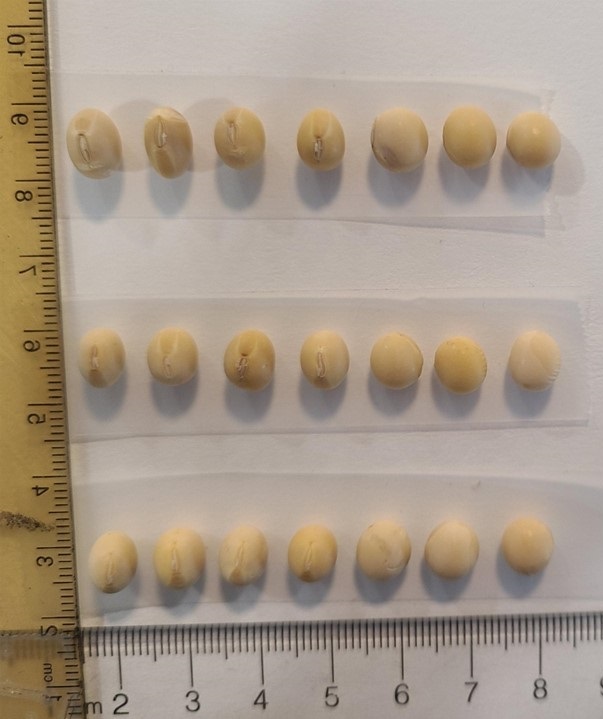
Soybean: 'Wilma' (top) with reference varieties 'Aya' (middle) and 'Genesis' (bottom)
- Date modified: