
Molto
| Denomination: | 'Molto' |
|---|---|
| Botanical Name: | Glycine max |
| Applicant/Holder: |
Sevita Genetics 11451 Cameron Rd. Inkerman, Ontario K0E1J0 Canada |
| Breeder: |
Mark MacDuff, Sevita Genetics, Inkerman, Ontario |
| Application Date: | 2024-02-22 |
| Provisional Protection: | 2024-02-22 |
| Application Number: | 24-11613 |
Variety Description
Varieties used for comparison: 'RD714' and 'Taku'
Summary: Flowering begins earlier for the plants of ‘Molto' than for the plants of ‘Taku'. When 50% of the flowers are open, the branching attitude of ‘Molto' is erect whereas it is semi-erect on ‘Taku'. From 50% flowering to 95% pods ripe, the hairs on the middle third of the stem of ‘Molto' are grey whereas they are light tawny for ‘Taku' and tawny for ‘RD714'. When 95% of the pods are ripe, the intensity of brown colour on the pod of ‘Molto' is light whereas it is of medium intensity on the pod of ‘Taku'. The plants of ‘Molto' mature earlier than the plants of ‘Taku' and later than the plants of ‘RD714'.
Description:
HYPOCOTYL: anthocyanin colouration present
PLANT: oilseed type, indeterminate growth type, erect branch attitude, grey pubescence on middle third of main stem, begins flowering early to mid-season, matures mid-season
LEAF: pointed ovate lateral leaflet
FLOWER: violet
POD: medium intensity of brown
SEED: medium size, spherical flattened, yellow ground colour of testa
HILUM: yellow
Origin & Breeding History: ‘Molto' (experimental designations SVX22H0S42 and SC10-11.32) originated from a cross between the varieties ‘OAC Lakeview' and ‘RD714' conducted in 2010 in Saint-Urbain, Québec, Canada. A modified individual pedigree selection method was used to develop the variety. From 2011 to 2018, the population and selected plants were grown and evaluated for lodging resistance, yield, maturity and resistance to diseases. In 2019, the selected F7 subline SC10-11.32 was designated as the variety ‘Molto' and tested in replicated private yield trials in Quebec and Ontario. In 2020, a purification process based on the uniformity of visual characters such as flower colour, pod colour, pubescence colour, hilum colour, and genetic markers was carried out to produce breeder seed. In 2022, breeder seed was bulked at the F10 generation.
Tests & Trials: The comparative trials for ‘Molto' were conducted in 2023 and 2024 at the research farm in Saint-Cesaire, Quebec, Canada. The trials were arranged in a RCB design with 2 replicates per variety. Each 7.6 square metre plot consisted of 2 rows, each 5 metres long with inter-row spacing 0.76 metres. Plants were spaced 0.33 metres apart and the planting density resulted in a total of 350 plants per variety. Measurements were taken from 20 plants or parts of 20 plants of each variety per year.
Comparison tables for 'Molto' with reference varieties 'RD714' and 'Taku'
Flowering date (number of days from planting to when 50% of the plants have one flower open)
| 'Molto' | 'RD714' | 'Taku' | |
|---|---|---|---|
| mean 2023 | 46 | 45 | 51 |
| mean 2024 | 43 | 41 | 46 |
Maturity date (number of days from planting to maturity)
| 'Molto' | 'RD714' | 'Taku' | |
|---|---|---|---|
| mean 2023 | 128 | 120 | 132 |
| mean 2024 | 115 | 111 | 122 |
Click on image for larger view
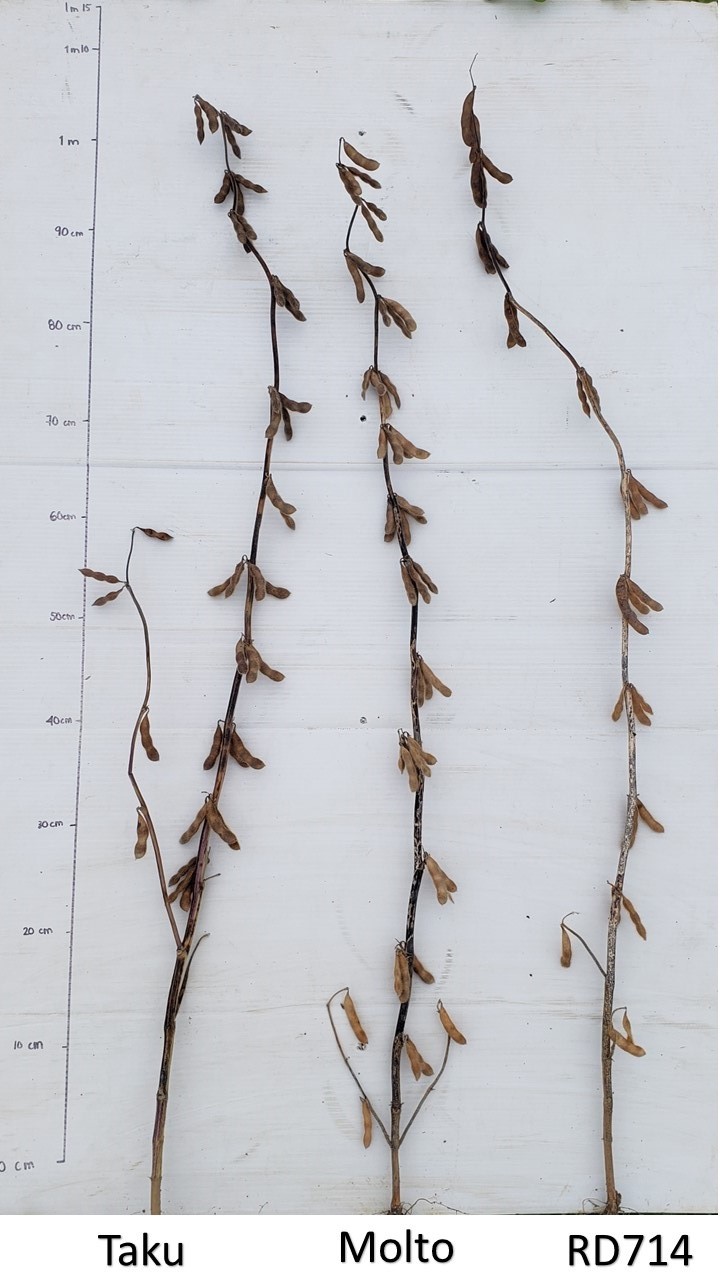
Soybean: 'Molto' (centre) with reference varieties 'Taku' (left) and 'RD714' (right).
- Date modified: