
RC Chippewa
| Denomination: | 'RC Chippewa' |
|---|---|
| Botanical Name: | Panicum virgatum |
| Applicant/Holder: |
REAP-Canada Box 125 21111 Lakeshore Rd Ste-Anne-de-Bellevue, Quebec H9X 3V9 Canada |
| Breeder: |
Roger Samson, REAP-Canada, Notre Dame de L'Ile Perrot, Quebec Erik Delaquis, REAP-Canada, Summerland, British Columbia |
| Application Date: | 2020-01-29 |
| Provisional Protection: | 2020-01-29 |
| Application Number: | 20-10085 |
Variety Description
Varieties used for comparison: 'RC Big Rock', 'Cave-in-Rock', 'Shawnee' and 'Blackwell'
Summary: The panicles of ‘RC Chippewa' emerge earlier than those of ‘RC Big Rock', ‘Cave-in-Rock', ‘Shawnee' and ‘Blackwell'. The plants of ‘RC Chippewa' have fewer tillers than the plants of ‘Cave-in-Rock', ‘Shawnee' and ‘Blackwell'. The stem width at the midpoint of the 3rd internode from the bottom of the plant of ‘RC Chippewa' is broader than those of Cave-in-Rock', ‘Shawnee', and ‘Blackwell'. At maturity, the plants of ‘RC Chippewa' are taller than the plants of ‘Cave-in-Rock', ‘Shawnee' and ‘Blackwell'. The plants of ‘RC Chippewa' mature earlier than those of the reference varieties.
Description:
PLANT: octoploid, agricultural or conservational utilisation, panicles emerge mid to late in the season, erect to semi-erect growth habit at soft dough stage, low number of total vegetative and reproductive tillers, matures mid-late season
FLAG LEAF: erect to semi-erect
LEAF BLADE: blue green on upper side, medium width at widest point
STEM: medium to high number of internodes
INTERNODE (3RD INTERNODE FROM BOTTOM OF PLANT): medium to broad at mid-section
PANICLE: medium to long
Origin & Breeding History: ‘RC Chippewa' originated from seed harvested in 2009 from 30 plants of the upland switchgrass variety ‘Cave-in-Rock' grown in a field in St. Timothée, Quebec. Having survived over 12 winter seasons, 30 plants were visually selected for maturity, plant height, growth habit, lodging, biomass production and disease reaction with 10 % of the heaviest harvested seed retained. In the spring of 2010, the seed was sown in a greenhouse with 200 seedlings selected based on robustness and reduced tillering and transplanted into a space-plant field nursery with suboptimal nitrogen levels. In 2012, further selections were made based on time of heading, maturity, plant height, biomass yield per tiller, leaf habit, stem thickness, leaf attitude, lodging, tiller number and visual assessment of disease reactions. Seed was harvested from 160 selected plants in the fall of 2012 and sown in a greenhouse. Two hundred plants selected based on time of emergence, length of second leaf, seedling height and growth habit, number of tillers and primary tiller height, leaf attitude, leaf width and visual assessment of biomass yield and absence of disease. The 200 greenhouse plants were space planted in 2013 in a fine sandy loam field with with no fertilizer applied. Late maturing plants were removed and seed was harvested in the fall of 2013. In 2014 another breeding cycle was repeated but was kept for 2 years to better assure a population of uniform maturity. Pre breeder seed production commenced by harvesting 12 tillers from each of 160 plants in the 2015 nursery using the same selection criteria as described above as well as presence of glaucous bloom.
Tests & Trials: The comparative trials for ‘RC Chippewa' were conducted by REAP Canada during the 2022 and 2023 growing seasons at the Emile A. Lods Agronomy Research Centre, at the MacDonald Campus of McGill University in Sainte-Anne-de-Bellevue, Quebec. Plots were arranged in a RCB design with 3 replicates per variety per year. Each plot measuring 2.4 x 1.8 metres contained 20 plants resulting in 60 plants per variety per year. Measured characteristics were based on 30 measurements per variety per year. Mean differences were significant at the 5% confidence probability level based on pairwise comparisons using a post hoc Tukey's Honest Significant Difference Test.
Comparison tables for 'RC Chippewa' with reference varieties 'RC Big Rock', 'Cave-in-Rock', 'Shawnee' and 'Blackwell'
Time of panicle emergence (number of days from January 1 to when the panicle can be seen on 50% of the plants)
| 'RC Chippewa' | 'RC Big Rock' | 'Cave-in-Rock' | 'Shawnee' | 'Blackwell' | |
|---|---|---|---|---|---|
| mean 2022 | 186 | 188 | 188 | 188 | 188 |
| mean 2023 | 191 | 196 | 195 | 194 | 196 |
Tiller number (total number of reproductive and vegetative tillers)
| 'RC Chippewa' | 'RC Big Rock' | 'Cave-in-Rock' | 'Shawnee' | 'Blackwell' | |
|---|---|---|---|---|---|
| mean 2022 (HSD=8.94) | 26.7 | 35.4 | 46.4 | 47.1 | 50.8 |
| std. deviation (2022) | 8.17 | 7.81 | 11.85 | 16.61 | 16.00 |
| mean 2023 (HSD=15.4) | 52.9 | 60.6 | 88.7 | 78.4 | 100.2 |
| std. deviation 2023 | 17.94 | 14.04 | 22.51 | 29.40 | 23.38 |
Stem width (at the midpoint of the 3rd internode from the bottom of the plant) (mm)
| 'RC Chippewa' | 'RC Big Rock' | 'Cave-in-Rock' | 'Shawnee' | 'Blackwell' | |
|---|---|---|---|---|---|
| mean 2022 (HSD=0.41) | 3.7 | 3.9 | 3.3 | 3.3 | 3.0 |
| std. deviation 2022 | 0.60 | 0.65 | 0.57 | 0.55 | 0.51 |
| mean 2023 (HSD=0.45) | 4.7 | 4.6 | 3.9 | 3.9 | 3.6 |
| std. deviation 2023 | 0.74 | 0.64 | 0.73 | 0.43 | 0.51 |
Plant height (including panicle at maturity) (cm)
| 'RC Chippewa' | 'RC Big Rock' | 'Cave-in-Rock' | 'Shawnee' | 'Blackwell' | |
|---|---|---|---|---|---|
| mean 2022 (HSD=9.56) | 166.8 | 168.1 | 154.6 | 151.9 | 147.1 |
| std. deviation 2022 | 9.90 | 15.47 | 14.19 | 12.16 | 16.21 |
| mean 2023 (HSD=13.58) | 195.3 | 195.7 | 175.1 | 181.5 | 162.5 |
| std. deviation 2023 | 13.6 | 21.9 | 25.6 | 13.2 | 20.0 |
Plant maturity (number of days from January 1 to beginning of senescence)
| 'RC Chippewa' | 'RC Big Rock' | 'Cave-in-Rock' | 'Shawnee' | 'Blackwell' | |
|---|---|---|---|---|---|
| mean 2022 | 273 | 282 | 281 | 282 | 277 |
| mean 2023 | 275 | 282 | 279 | 282 | 278 |
Click on image for larger view
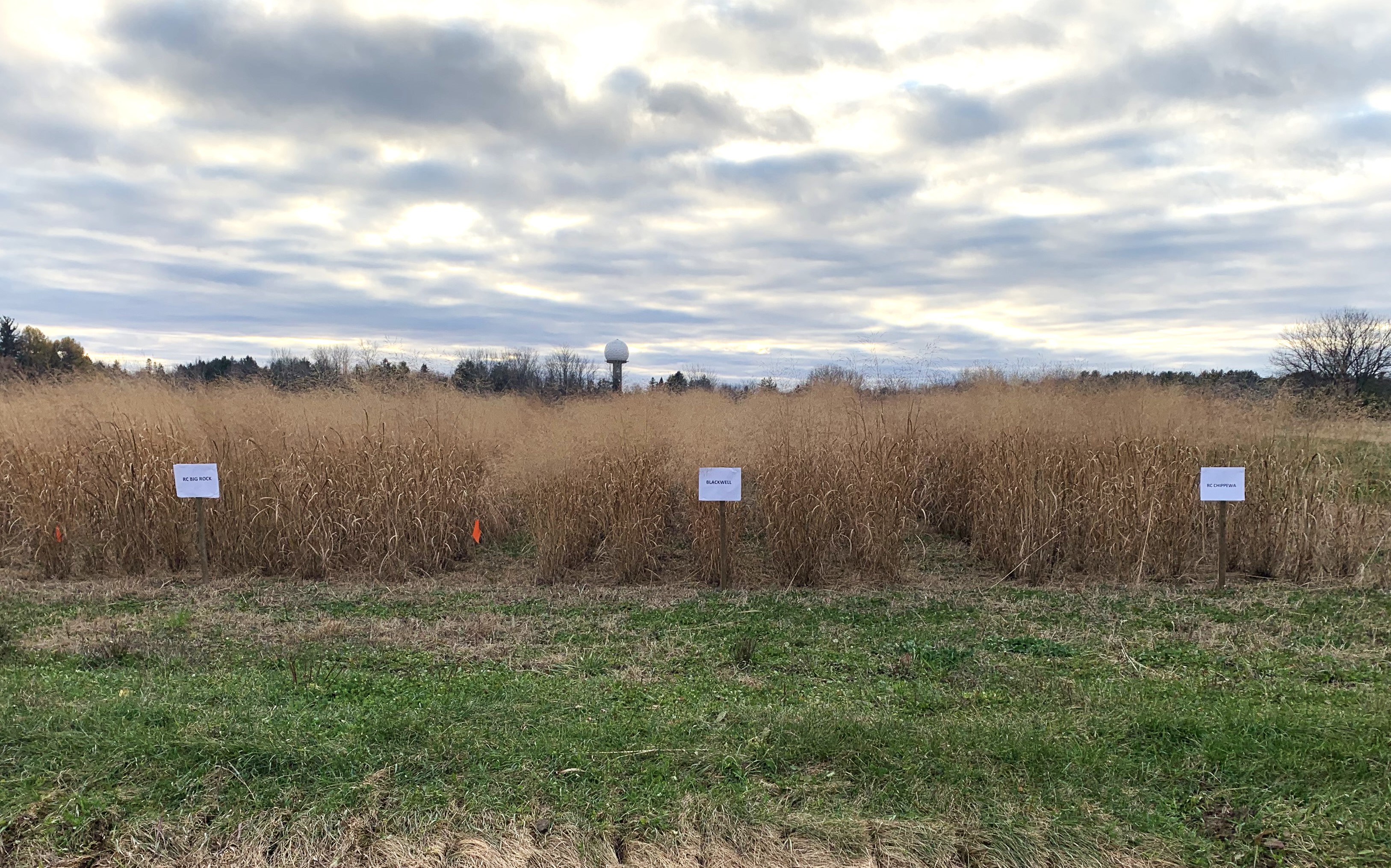
Switchgrass: ‘RC Chippewa' (right) with reference varieties ‘Blackwell' (centre) and ‘RC Big Rock' (left)
Click on image for larger view
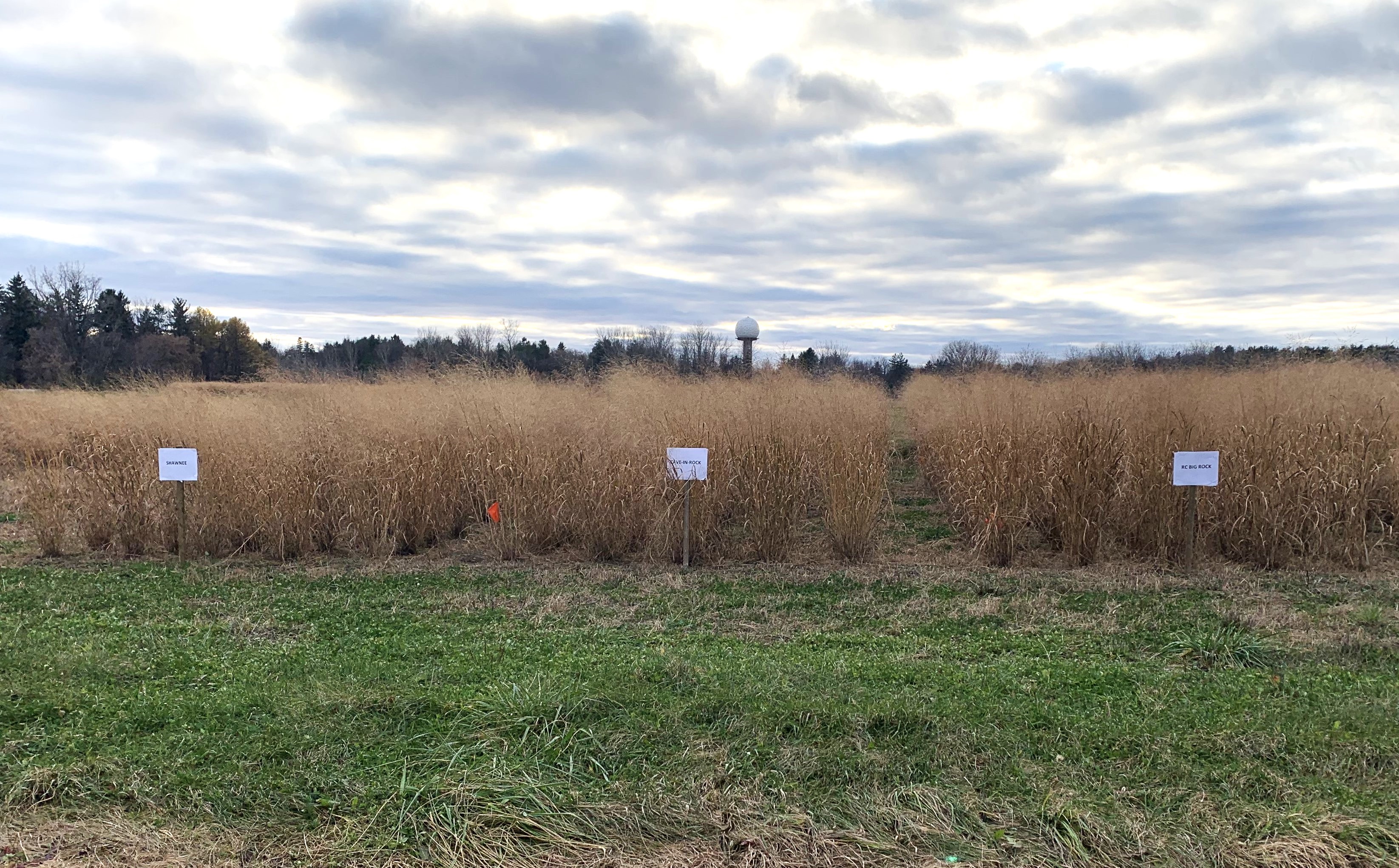
Switchgrass: Reference varieties ‘Shawnee' (left), ‘Cave-in-Rock' (centre) and ‘RC Big Rock' (right)
- Date modified: