
UGRC Comet
| Denomination: | 'UGRC Comet' |
|---|---|
| Previously Proposed Denomination: | '12w932-349' |
| Botanical Name: | Triticum aestivum |
| Applicant/Holder: |
University of Guelph Germplasm Research Innovation Office Building #92, 50 Stone Road East Guelph, Ontario N1G 2W1 Canada |
| Breeder: |
Ljiljana Tamburic-Ilincic, University of Guelph, Ridgetown Campus, Ridgetown, Ontario |
| Application Date: | 2021-05-04 |
| Provisional Protection: | 2021-05-04 |
| Application Number: | 21-10533 |
| Grant of Rights Date: | 2025-11-12 |
| Certificate Number: | 7527 |
| Grant of Rights Termination Date: | 2045-11-12 |
Variety Description
Varieties used for comparison: 'Branson', 'Cruze' and 'Hilliard'
Summary: At the 5-9 tiller stage,‘UGRC Comet' has an erect growth habit while the reference varieties have a semi-erect growth habit. At booting, the flag leaf of ‘UGRC Comet' is wider than those of ‘Branson' and ‘Hilliard'. At heading, the spike of 'UGRC Comet' has a medium degree of glaucosity while the spike of ‘Cruze' has weak glaucosity and that of ‘Hilliard' has strong glaucosity. The spike of 'UGRC Comet' is tapering in profile while the spike of ‘Branson' is parallel sided in profile. Excluding the awns and awnlets, the spike of 'UGRC Comet' is longer than those of the reference varieties. The spike of 'UGRC Comet' is awnletted while those of ‘Cruze' and ‘Hilliard'are awned. At maturity, including the spike and awns, the plants of 'UGRC Comet' are taller than the plants of ‘Hilliard'. The lower glume beak of ‘UGRC Comet' is very short while the lower glume beak is short for ‘Branson', medium in length for ‘Cruze' and long for ‘Hilliard'. The kernel of ‘UGRC Comet' is medium red while that of ‘Cruze' is light red.
Description:
PLANT: common winter type, erect growth habit at 5 to 9 tiller stage, heads mid-season, matures early in the season
SEEDLING (4-leaf stage): absent or very weak intensity of anthocyanin colouration of coleoptile, glabrous sheath and blade of lower leaves
FLAG LEAF: absent or very weak intensity of anthocyanin colouration of auricles, medium degree of glaucosity of sheath, glabrous blade and sheath
CULM: straight neck
STRAW (AT MATURITY): thin pith in cross-section, no anthocyanin colouration
SPIKE: medium degree of glaucosity at heading, tapering shape in profile, medium density, white at maturity, inclined to nodding attitude
AWNLETS: shorter than length of spike, white at maturity
LOWER GLUME: short, medium width
LOWER GLUME SHOULDER: medium width
LOWER GLUME BEAK: very short, straight
LOWEST LEMMA: straight beak
KERNEL: soft red type, medium red, medium sized, medium length and width, oval, rounded cheek, medium length brush hairs, narrow and shallow crease
GERM: medium sized, oval
AGRONOMIC CHARACTERISTICS: fair to good tolerance to drought, good winter survival
PASTRY AND BISCUIT QUALITY: good
DISEASE REACTION: moderately resistant to powdery mildew (Erysiphe graminis, f.sp. tritici); moderately susceptible to Fusarium Head Blight (Fusarium graminearum) and Septoria leaf spot (Mycosphaerella graminicola)
Origin & Breeding History: 'UGRC Comet' (experimental designation 12w932-349) originated from the cross between the variety ‘Marker' and the line DH5-78 conducted at the University of Guelph, Ridgetown Campus, in Ridgetown, Ontario in 2012. From the F1 population, 103 DH lines were developed using the wheat-maize wide hybridization method in 2014. From 2015 to 2018, selections were made based on yield, disease resistance, agronomic performance and quality characteristics with the line 12w932-349 identified in 2015. The variety was tested across Ontario in orthogonal pastry trials in 2018 and 2019 and entered in the Registration trials conducted by the Ontario Cereal Crop Committee in 2022 and 2023. Breeder seed production commenced in 2021.
Tests & Trials: The comparative trials for 'UGRC Comet' were conducted during the 2022 and 2024 growing seasons at the University of Guelph, Ridgetown Campus, in Ridgetown, Ontario. The trials were arranged in a RCB Design with 4 replicates. Each plot consisted of 6 rows, each 4.0 metres long with 40 centimetres inter-row spacing. The seeding density of 400 seeds per square metre resulted in approximately 8000 plants per variety per year. Measured characteristics were based on a minimum of 20 measurements per variety per year. Mean differences were significant at the 5% confidence probability level based on a Student`s t-test. Disease ratings were provided through the Disease Evaluation Team of the Ontario Cereal Crops Committee.
Comparison tables for 'UGRC Comet' with reference varieties 'Branson', 'Cruze' and 'Hilliard'
Flag leaf width(cm)
| 'UGRC Comet' | 'Branson' | 'Cruze' | 'Hilliard' | |
|---|---|---|---|---|
| mean 2022 | 1.4 | 1.2 | 1.3 | 1.3 |
| std. deviation 2022 | 0.1 | 0.1 | 0.1 | 0.1 |
| mean 2024 | 1.5 | 1.2 | 1.4 | 1.3 |
| std. deviation 2024 | 0.1 | 0.1 | 0.1 | 0.1 |
Spike length (excluding the awns or awnlets) (cm)
| 'UGRC Comet' | 'Branson' | 'Cruze' | 'Hilliard' | |
|---|---|---|---|---|
| mean 2022 | 8.9 | 7.6 | 8.2 | 7.8 |
| std. deviation 2022 | 0.8 | 0.8 | 0.8 | 0.8 |
| mean 2024 | 8.9 | 8.0 | 7.6 | 7.8 |
| std. deviation 2024 | 0.7 | 0.4 | 0.8 | 0.6 |
Plant height (stem plus spike including awns or awnlets) (cm)
| 'UGRC Comet' | 'Branson' | 'Cruze' | 'Hilliard' | |
|---|---|---|---|---|
| mean 2022 | 91.6 | 92.4 | 92.5 | 90.6 |
| std. deviation 2022 | 0.60 | 2.60 | 5.60 | 1.60 |
| mean 2024 | 118.0 | 111.0 | 114.0 | 115.0 |
| std. deviation 2024 | 2.05 | 2.04 | 2.03 | 2.07 |
Click on image for larger view
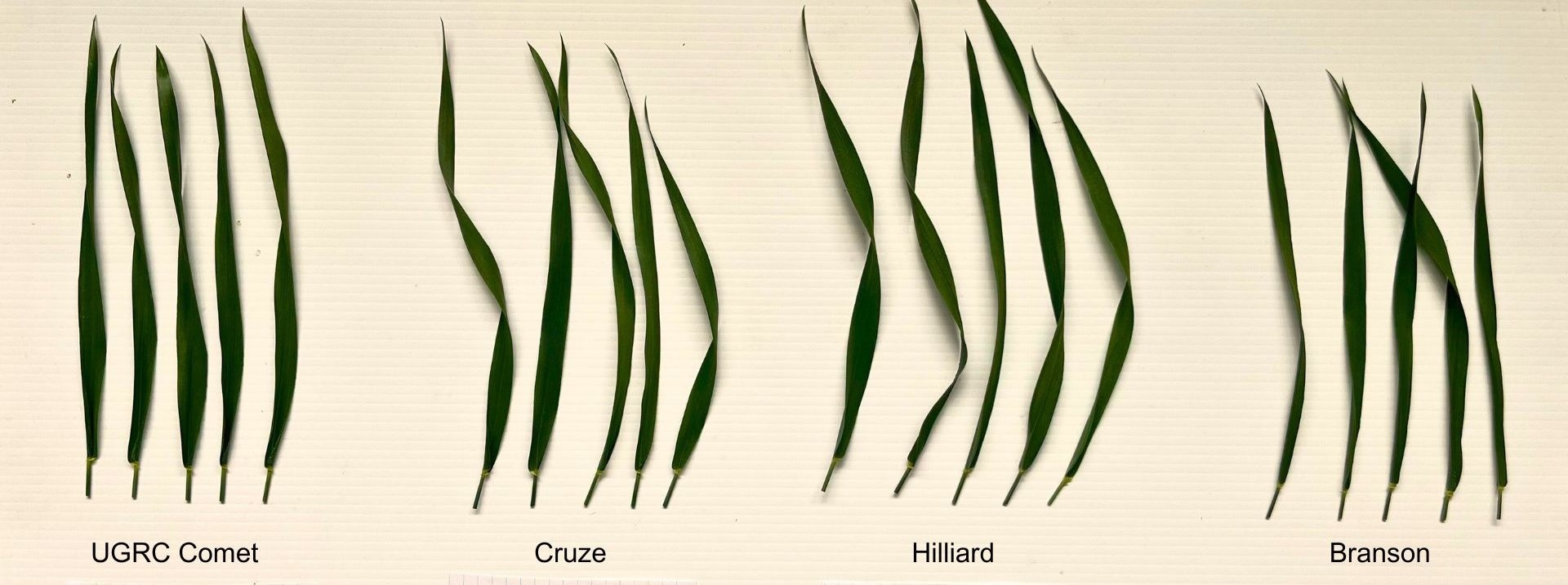
Wheat: ‘UGRC Comet' (left) with reference varieties ‘Cruze' (centre left), ‘Hilliard' (centre right) and ‘Branson' (right)
Click on image for larger view
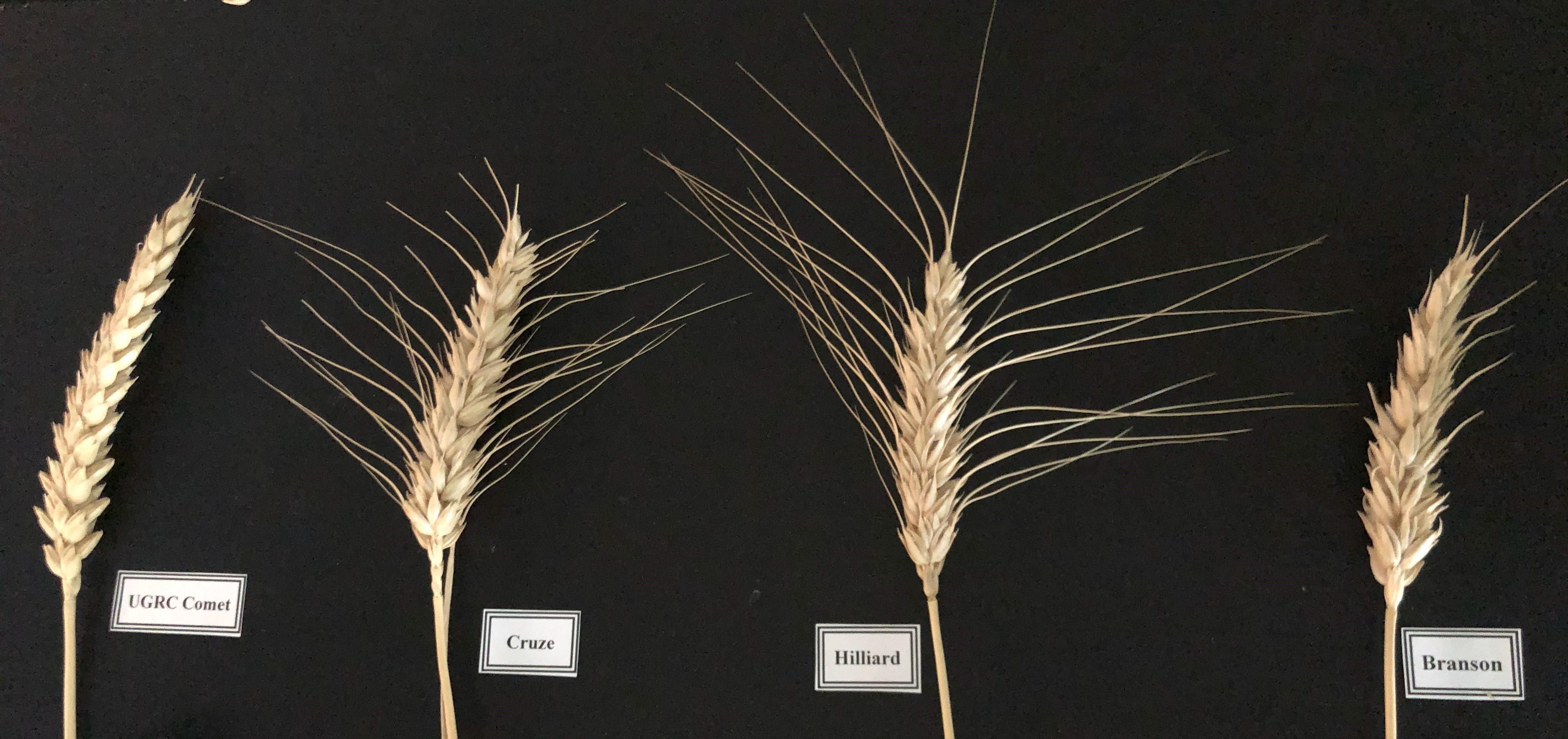
Wheat: ‘UGRC Comet' (left) with reference varieties ‘Cruze' (centre left), ‘Hilliard' (centre right) and ‘Branson' (right)
Click on image for larger view
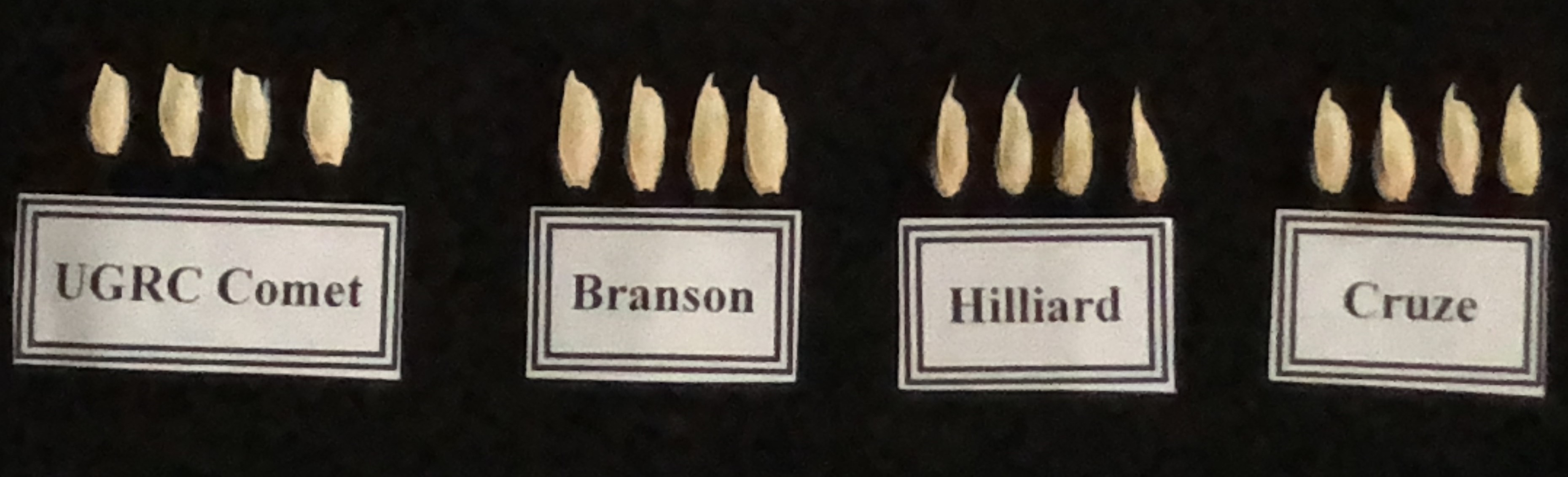
Wheat: ‘UGRC Comet' (left) with reference varieties ‘Branson' (centre left), ‘Hilliard' (centre right) and ‘Cruze' (right)
- Date modified: