
CDC Bandit
| Denomination: | 'CDC Bandit' |
|---|---|
| Previously Proposed Denomination: | '15FOR36' |
| Botanical Name: | Triticum aestivum |
| Applicant/Holder: |
University of Saskatchewan Crop Development Centre 4D36 Agriculture Building, 51 Campus Drive Saskatoon, Saskatchewan S7N 5A8 Canada |
| Breeder: |
Pierre Hucl, University of Saskatchewan, Saskatoon, Saskatchewan |
| Application Date: | 2024-04-26 |
| Provisional Protection: | 2024-04-26 |
| Application Number: | 24-11666 |
| Grant of Rights Date: | 2026-02-03 |
| Certificate Number: | 7629 |
| Grant of Rights Termination Date: | 2046-02-03 |
Variety Description
Varieties used for comparison: 'CDC Plentiful' and 'CDC Utmost'
Summary: At booting, the frequency of plants with recurved flag leaves for ‘CDC Bandit' is high to very high while it is medium to high for ‘CDC Utmost' and low for ‘CDC Plentiful'. The flag leaf of ‘CDC Bandit' is longer than the flag leaf of ‘CDC Utmost' and wider than that of ‘CDC Plentiful'. Excluding the awns and awnlets, the spike of ‘CDC Bandit' is longer than those of the reference varieties. The spike of 'CDC Bandit' is awnless while those of the reference varieties are awnletted. The culm neck of 'CDC Bandit' is straight while those of the reference varieties are curved. The lower glume shoulder of 'CDC Bandit' is narrow while those of the reference varieties are medium to wide. The lower glume shoulder of 'CDC Bandit' is elevated to strongly elevated with a second point present while the lower glume shoulder of ‘CDC Utmost' is straight and that of ‘CDC Plentiful' is slightly sloping to straight. The lower glume beak of 'CDC Bandit' is geniculate in shape while the lower glume beak of ‘CDC Utmost' is straight to slightly curved and that of ‘CDC Plentiful' is very slightly to slightly curved. The lowest lemma of ‘CDC Bandit' has a geniculate shaped beak while those of the reference varieties have a slightly to moderately curved beak. The kernel of 'CDC Bandit' is medium red in colour while that of ‘CDC Plentiful' is light red.
Description:
PLANT: common spring type, erect growth habit at 5 to 9 tiller stage, high to very high frequency of plants with recurved flag leaves, heads late in the season
SEEDLING (4-leaf stage): absent or very weak intensity of anthocyanin colouration of coleoptile, glabrous sheath and blade of lower leaves
FLAG LEAF: absent or very weak intensity of anthocyanin colouration of auricles, weak to medium degree of glaucosity of sheath, glabrous blade and sheath
CULM: weak to medium degree of glaucosity at heading, straight neck
STRAW (AT MATURITY): very thin to thin pith in cross-section, no anthocyanin colouration
SPIKE: weak glaucosity at heading, tapering shape in profile, medium density, awnless, white at maturity, erect attitude, dense to very dense pubescence of convex surface of apical rachis segment
LOWER GLUME: medium to long, medium to broad, glabrous, sparse to medium extent of internal hairs
LOWER GLUME SHOULDER: narrow, elevated to strongly elevated with second point present
LOWER GLUME BEAK: very short to short, geniculate
LOWEST LEMMA: geniculate shaped beak
KERNEL: hard red type, medium red, medium size, medium length and width, ovate, rounded cheek, medium to long brush hairs, medium width crease of medium depth
GERM: medium sized, round to broad elliptical
Origin & Breeding History: 'CDC Bandit' (experimental designation 15FOR36) originated from the cross between the female parent Ar01.7-236(B) and the male parent 05Mex-off12-87 conducted at the Crop Development Centre, University of Saskatchewan in Saskatoon, Saskatchewan in 2005. The F1 plants were grown as rows in 2006 with the subsequent F2 to F6 generations grown as bulk plots from 2007 to 2011. Selected F6 spikes were planted as F7 hills in 2012 and F8 hills in 2013 with subsequent selections made in both generations based on lodging, shattering resistance and plant height. In 2015 and 2016, the F9 and F10 generations were assessed in unreplicated yield trials where selections were made based on grain yield, awnedness and disease reaction, with one line identified as 15FOR36 in 2016. 15FOR36 was assessed for forage yield from 2017 to 2019 with further selections made based on forage yield, forage quality and disease reaction. The line was entered in the Forage Spring Wheat Trial from 2020 to 2023. Breeder seed was established at the F16 generation in 2021.
Tests & Trials: The comparative trials for 'CDC Bandit' were conducted during the 2022 and 2024 growing seasons at the Crop Development Centre, University of Saskatchewan in Saskatoon, Saskatchewan. There were 4 replicates arranged in a RCB design. Each 4.25 metre squared plot consisted of 5 rows, with 23 centimetre inter-row spacing. The planting density of 250 seeds per square metre resulted in approximately 3100 plants per variety per year. Measured characteristics were based on 20 measurements per variety per year. Mean differences were significant at the 5% confidence probability level based on LSD values.
Comparison tables for 'CDC Bandit' with reference varieties 'CDC Plentiful' and 'CDC Utmost'
Flag leaf length(cm)
| 'CDC Bandit' | 'CDC Plentiful' | 'CDC Utmost' | |
|---|---|---|---|
| mean 2022 (LSD=1.6) | 29.6 | 21.1 | 16.3 |
| std. deviation 2022 | 3.5 | 2.0 | 1.5 |
| mean 2024 (LSD=1.4) | 21.0 | 21.0 | 17.9 |
| std. deviation 2024 | 2.1 | 2.7 | 1.8 |
Flag leaf width (mm)
| 'CDC Bandit' | 'CDC Plentiful' | 'CDC Utmost' | |
|---|---|---|---|
| mean 2022 (LSD=0.7) | 16.7 | 14.6 | 15.0 |
| std. deviation 2022 | 1.6 | 0.9 | 0.8 |
| mean 2024 (LSD=0.6) | 15.1 | 14.4 | 14.6 |
| std. deviation 2024 | 0.8 | 1.2 | 0.9 |
Spike length (excluding awns and awnlets) (cm)
| 'CDC Bandit' | 'CDC Plentiful' | 'CDC Utmost' | |
|---|---|---|---|
| mean 2022 (LSD=0.4) | 11.3 | 7.8 | 7.7 |
| std. deviation 2022 | 0.7 | 0.4 | 0.5 |
| mean 2024 (LSD=0.3) | 11.1 | 7.8 | 7.2 |
| std. deviation 2024 | 0.6 | 0.3 | 0.3 |
Click on image for larger view
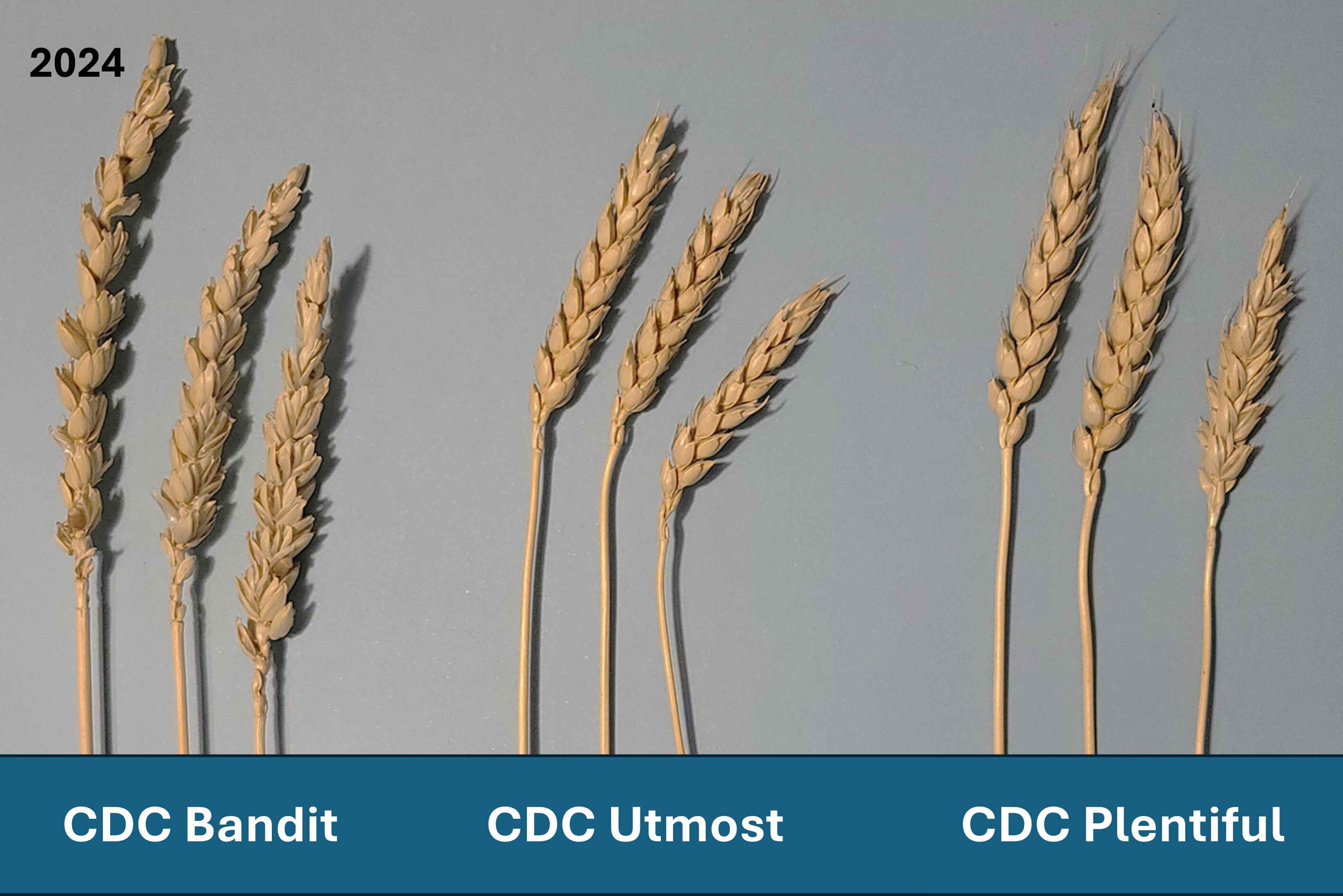
Wheat: ‘CDC Bandit' (left) with reference varieties ‘CDC Utmost' (centre) and ‘CDC Plentiful' (right)
Click on image for larger view
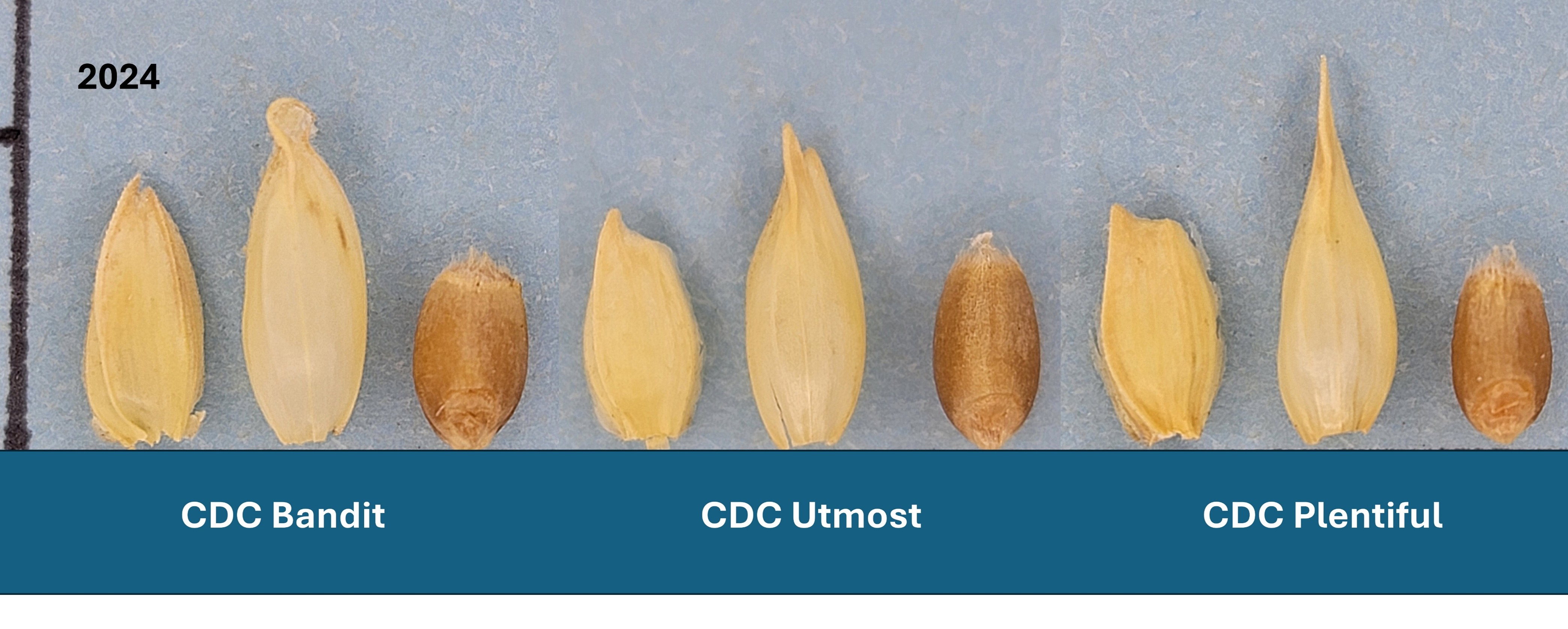
Wheat: ‘CDC Bandit' (left) with reference varieties ‘CDC Utmost' (centre) and ‘CDC Plentiful' (right)
- Date modified: