
WPB Banff
| Denomination: | 'WPB Banff' |
|---|---|
| Botanical Name: | Triticum aestivum |
| Applicant/Holder: |
Wiersum Plantbreeding BV Zeefbaan 28, 9672 BN P.O.Box 8, 9670 AA Winschoten Netherlands |
| Breeder: |
Ingeborg Westerdijk-Hoks, Wiersum Plantbreeding, Netherlands |
| Agent in Canada: |
SeCan Association 400-300 Terry Fox Drive Kanata, Ontario K2K 0E3 Canada Tel: 613-592-8600 ext.223 |
| Application Date: | 2025-04-22 |
| Provisional Protection: | 2025-04-22 |
| Application Number: | 25-12018 |
Variety Description
Varieties used for comparison: 'Pasteur' and 'WPB Whistler'
Summary: At the 4-leaf stage, the lower leaf blade of ‘WPB Banff' is glabrous whereas it is pubescent for ‘Pasteur'. At booting, the glaucosity on the lower side of the flag leaf blade ranges between medium to strong for ‘WPB Banff' whereas it is weak for ‘Pasteur' and of a weak to medium degree for ‘WPB Whistler'. The plants of ‘WPB Banff' head earlier than those of ‘WPB Whistler'. At maturity, the plants, including the awnlets, of ‘WPB Banff' are shorter than those of ‘Pasteur'.
Description:
PLANT: common wheat, spring type, erect to semi-erect growth habit at the 5 to 9 tiller stage, heads emerge mid to late season
SEEDLING (4-LEAF STAGE): glabrous sheath and blade of lower leaves
FLAG LEAF: absent or very weak intensity of anthocyanin colouration of auricles, strong glaucosity of sheath, glaucosity on lower side of blade ranges between medium to strong
STRAW (AT MATURITY): thin to medium pith in cross section
SPIKE: medium degree of glaucosity at heading, parallel-sided to tapering shape in profile, medium to dense, yellowish white at maturity, erect attitude
AWNLETS: present, shorter than spike length
LOWER GLUME: glabrous
KERNEL: medium to dark red
Origin & Breeding History: 'WPB Banff' (experimental designations WPB 16SW005-03 and GP266) originated from the cross between WPB10SW070-02 and WPB13SD843-07 made in 2016 at the Wiersum Plant Breeding Station near Dronten, The Netherlands. The F1 and F2 generations were grown in a greenhouse while the F3 generation was bulked from the field at the Wiersum Plant Breeding Station. In 2017 and 2018, F4 and F5 head rows were grown in the field and selections made based on heading time, plant height, disease resistance and lodging resistance. In 2019, F5 lines were selected based on the specific weight, thousand grain weight and screened for protein content, Zeleny sedimentation value, kernel hardness and wet gluten. In 2020, seven F6 lines were planted in observations trials in a disease nursery in Fort Whyte, Manitoba, Canada. One of these seven F7 lines was entered as WPB 16SW005-03 into yield trials and assessed for agronomic performance in five locations in 2021. This line was further advanced to the Special Purpose Registration Trials as GP266 from 2022 to 2024. Breeder seed was established in 2025 from a bulk of 68 F9 derived F11 head rows.
Tests & Trials: The comparative trials for 'WPB Banff' were conducted near Fort Whyte, Manitoba during the 2024 and 2025 growing seasons. There were 4 replications arranged in an RCB design. Each plot consisted of 4 rows, with a row length of 4.5 metres spaced 18 cm apart. The planting density of 307 plants per metre squared resulted in 1000 plants per replicate per variety. Measured characteristics were based on 20 measurements per variety per year. Mean differences were significant at the 5% probability level based on LSD values.
Comparison tables for 'WPB Banff' with reference varieties 'Pasteur' and 'WPB Whistler'
Days to heading (number of days from planting to 50% of heads fully emerged from boot)
| 'WPB Banff' | 'Pasteur' | 'WPB Whistler' | |
|---|---|---|---|
| mean 2024 | 60 | 62 | 63 |
| mean 2025 | 54 | 55 | 56 |
Plant height at maturity (stem plus spike, including awnlets) (cm)
| 'WPB Banff' | 'Pasteur' | 'WPB Whistler' | |
|---|---|---|---|
| mean 2024 (LSD=1.3) | 88.3 | 93.5 | 87.1 |
| std. deviation 2024 | 2.6 | 2.1 | 2.0 |
| mean 2025 (LSD=1.8) | 69.5 | 75.7 | 70.4 |
| std. deviation 2025 | 3.4 | 1.9 | 3.5 |
Click on image for larger view
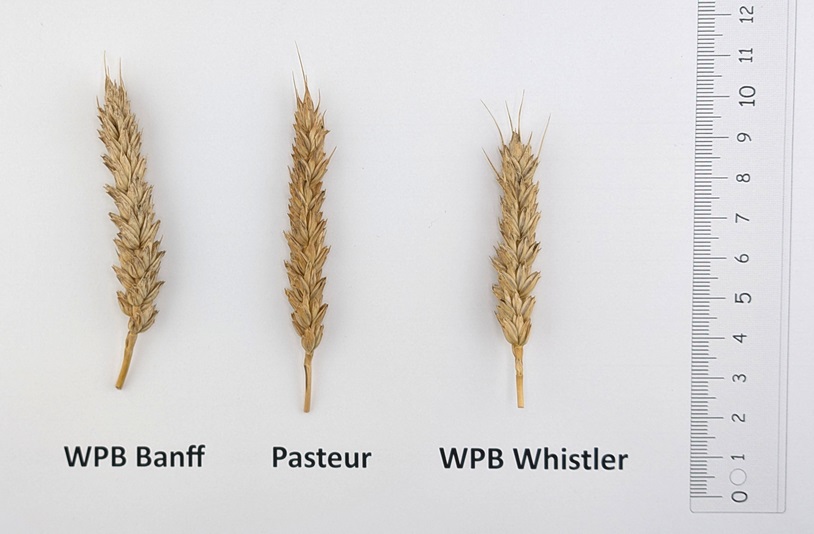
Wheat: ‘WPB Banff' (left) with reference varieties ‘Pasteur' (centre) and ‘WPB Whistler' (right)
- Date modified: