
AAC Ace
| Denomination: | 'AAC Ace' |
|---|---|
| Botanical Name: | Triticum aestivum |
| Applicant/Holder: |
Agriculture & Agri-Food Canada, Ottawa Ottawa Research and Development Centre Room 1093A - 960 Carling Avenue Ottawa, Ontario K1A 0C6 Canada |
| Breeder: |
Andrew Burt, Agriculture & Agri-Food Canada, Ottawa, Ontario Allan Cummiskey, Agriculture & Agri-Food Canada, Charlottetown, Prince Edward Island |
| Agent in Canada: |
Agriculture & Agri-Food Canada Office of Intellectual Property and Commercialization c/o Shannon Whyte 107 Science Place Saskatoon, Saskatchewan S7N 0X2 Canada Tel: (204) 999-9887 |
| Application Date: | 2025-04-30 |
| Provisional Protection: | 2025-04-30 |
| Application Number: | 25-12042 |
Variety Description
Varieties used for comparison: 'AAC Scotia' and 'AC Walton'
Summary: At the 4-leaf stage, the lower leaf blade for ‘AAC Ace' is glabrous whereas it is pubescent for ‘AAC Scotia'. At maturity, the plants, including the awnlets, of ‘AAC Ace' are shorter than those of ‘AAC Scotia' and taller than those of ‘AC Walton'. Excluding the awnlets, the spike of ‘AAC Ace' is shorter than the spike of ‘AAC Scotia'. The culm of ‘AAC Ace' has a straight neck whereas that of ‘AC Walton' has a curved neck. The lower glume shoulder of 'AAC Ace' is slightly sloping and of medium width whereas the lower glume shoulder is elevated and very broad for 'AC Walton'. The lower glume beak of ‘AAC Ace' is of medium length whereas that of ‘AC Walton' is very short. The beak on the lowest lemma of ‘AAC Ace' is slightly curved whereas that of ‘AC Walton' is straight. The kernel of ‘AAC Ace' is medium red whereas that of ‘AC Walton is dark red'. The kernel weight of ‘AAC Ace' is greater than that of the reference varieties. The brush hairs on the kernel of ‘AAC Ace' are short whereas those of ‘AAC Scotia' are medium to long. The germ on the kernel of ‘AAC Ace' is large and oval whereas that of ‘AC Walton is medium in size and broad elliptical.
Description:
SEEDLING (4-LEAF STAGE): absent or very weak intensity of anthocyanin colouration of coleoptile, glabrous sheath and blade of lower leaves
PLANT: common wheat, spring type, semi-erect to intermediate growth habit at 5 to 9 tiller stage, medium to high frequency of plants with recurved flag leaves, heads mid-season, matures mid-season
FLAG LEAF: weak to medium intensity of anthocyanin colouration of auricles, medium degree of glaucosity of sheath, glabrous blade and sheath
CULM: medium degree of glaucosity at anthesis, straight neck
STRAW (AT MATURITY): thin pith in cross-section
SPIKE: medium degree of glaucosity at anthesis, tapering shape in profile, medium to dense, white at maturity, inclined attitude, medium to dense hairiness of convex surface of apical rachis segment
AWNLETS: present, shorter than spike, white at maturity
LOWER GLUME: long, wide, pubescent, medium to dense extent of internal hairs
LOWER GLUME SHOULDER: medium width, slightly sloping
LOWER GLUME BEAK: medium length, straight
LOWEST LEMMA: slightly curved beak
KERNEL: hard red type, medium red, large, long, medium to wide, broad elliptical to elliptical in shape, angular cheek, short brush hairs, narrow crease, medium depth of crease
GERM: large, oval shape
BREAD MAKING QUALITY: good
DISEASE REACTION: moderately resistant to Fusarium head blight (Fusarium graminearum)
Origin & Breeding History: ‘AAC Ace' (experimental designations 14-21-1 and AW961) originated from a cross between the line AW783 and the variety ‘AAC Scotia' conducted in January 2014 at the Harrington Research Farm, which is part of the Agriculture and Agri-Food Canada Charlottetown Research and Development Centre in Prince Edward Island. The variety was advanced using a modified bulk breeding method. From the 120 single F4 plants selected in 2017 that were grown as headrows in 2018, one F5 line, designated as 14-21-1, was selected based on appearance, lodging resistance, grain yield and protein content. The variety was further assessed in preliminary yield and Fusarium head blight disease resistance trials. In 2022, the line 14-21-1 was entered in the Quebec Registration Recommending Trials as AW961 from 2022 to 2024. Additional selection criteria in the multi-location yield trials in Eastern Canada were thousand kernel weight, low deoxynivalenol contamination, flour yield and protein, falling number and mixograph testing. Breeder seed was established from 360 single F11 head rows in 2024.
Tests & Trials: The comparative trials for 'AAC Ace' were conducted at Agriculture and Agri-Food Canada, Ottawa Research and Development Centre in Ottawa, Ontario in 2024 and 2025. There were 3 replicates per variety arranged in an RCB design. Plots were 8.25 square metres, and consisted of 6 rows, 5.5 metres in length, with 0.25 metres between rows. The seeding density was 360 seeds per square metre, resulting in approximately 3000 plants per variety per year. Measured characteristics were based on a minimum of 20 measurements per variety per year. Mean differences were significant at the 5% probability level based on LSD values. Disease reaction ratings were provided through the disease evaluation team of the Quebec Registration Committee trials from 2022 to 2024.
Comparison tables for 'AAC Ace' with reference varieties 'AAC Scotia' and 'AC Walton'
Plant height at maturity (stem plus spike, including awnlets) (cm)
| 'AAC Ace' | 'AAC Scotia' | 'AC Walton' | |
|---|---|---|---|
| mean 2024 (LSD= 2.49) | 115.1 | 118.7 | 105.4 |
| std. deviation 2024 | 3.9 | 5.5 | 3.2 |
| mean 2025 (LSD=1.97) | 102.5 | 105.9 | 93.3 |
| std. deviation 2025 | 3.9 | 4.5 | 2.8 |
Spike length (excluding awnlets) (cm)
| 'AAC Ace' | 'AAC Scotia' | 'AC Walton' | |
|---|---|---|---|
| mean 2024 (LSD=0.54) | 9.44 | 10.2 | 8.6 |
| std. deviation 2024 | 1.2 | 1.1 | 1.0 |
| mean 2025 (LSD=0.43) | 8.87 | 10.2 | 8.7 |
| std. deviation 2025 | 0.64 | 0.7 | 0.8 |
Kernel weight (grams per 1000 kernels) (g)
| 'AAC Ace' | 'AAC Scotia' | 'AC Walton' | |
|---|---|---|---|
| mean 2024 (LSD=0.72) | 35.9 | 31.5 | 32.8 |
| std. deviation 2024 | 0.5 | 1.6 | 0.9 |
| mean 2025 (LSD=0.33) | 36.9 | 35.0 | 35.0 |
| std. deviation 2025 | 0.4 | 0.6 | 0.6 |
Click on image for larger view
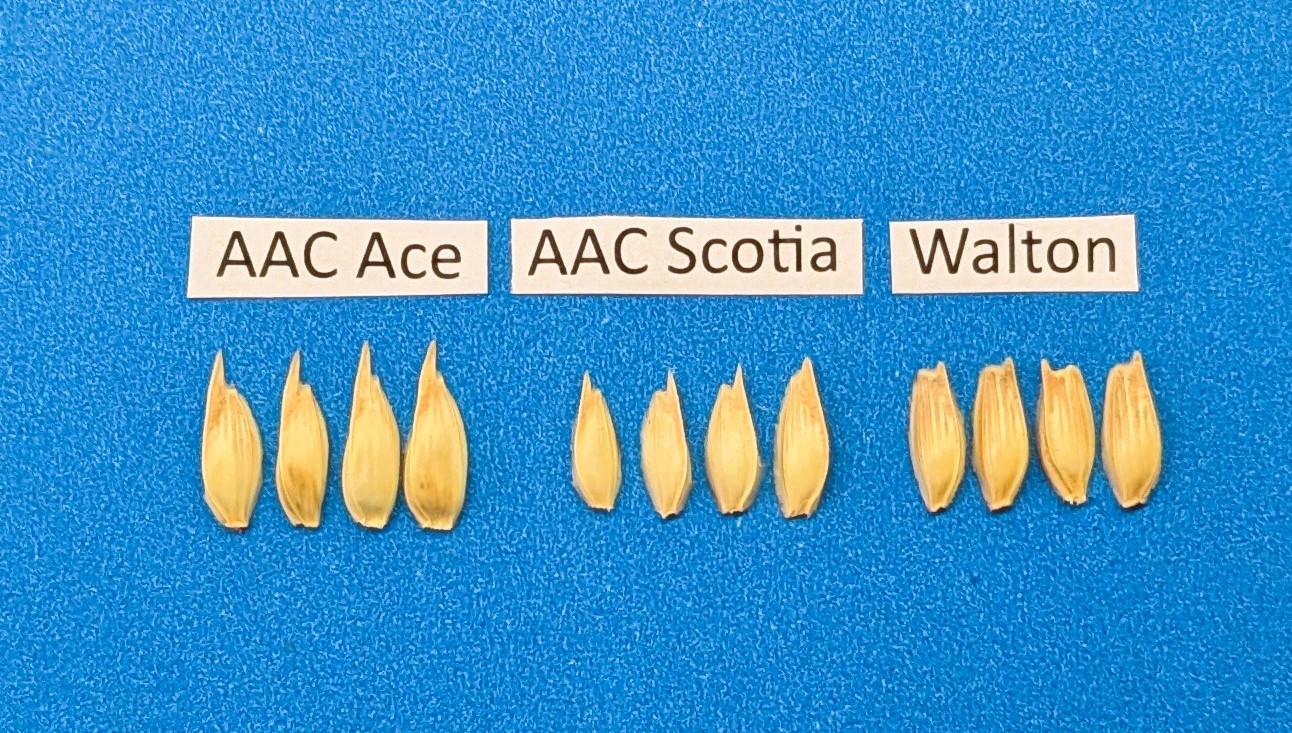
Wheat: ‘AAC Ace' (left) with reference varieties ‘AAC Scotia' (centre) and ‘AC Walton' (right)
- Date modified: