
AAC Ahead
| Denomination: | 'AAC Ahead' |
|---|---|
| Previously Proposed Denomination: | 'BW1141' |
| Botanical Name: | Triticum aestivum |
| Applicant/Holder: |
Agriculture & Agri-Food Canada, Brandon Brandon Research Centre, 18th St. & Grand Valley R P.O. Box 1000A, R.R. #3 Brandon, Manitoba R7A 5Y3 Canada |
| Breeder: |
Santosh Kumar, Agriculture & Agri-Food Canada, Brandon, Manitoba |
| Agent in Canada: |
Agriculture & Agri-Food Canada Office of Intellectual Property and Commercialization c/o Shannon Whyte 107 Science Place Saskatoon, Saskatchewan S7N 0X2 Canada Tel: (204) 999-9887 |
| Application Date: | 2025-04-25 |
| Provisional Protection: | 2025-04-25 |
| Application Number: | 25-12036 |
Variety Description
Varieties used for comparison: 'AAC Wheatland', 'AAC Hockley' and 'AAC Rivers'
Summary: At the 5 to 9 tiller stage, the plants of ‘AAC Ahead' range between an intermediate to semi-prostrate and semi-prostrate growth habit while the plants of ‘AAC Hockley' range between a semi-erect to intermediate and intermediate growth habit. At maturity, the plants, including the awns, of ‘AAC Ahead' are taller than the plants of 'AAC Wheatland' and ‘AAC Hockley'. The one thousand seed weight of ‘AAC Ahead' is less than that of ‘AAC Rivers'. The plants of ‘AAC Ahead' are moderately susceptible to moderately resistant to Leaf rust (Puccinia triticina) while the plants of 'AAC Rivers' are resistant.
Description:
PLANT: common wheat, spring type, ranging between intermediate to semi-prostrate and semi-prostrate growth habit at the 5 to 9 tiller stage, heads emerge mid-season
SEEDLING (4 LEAF STAGE): weak intensity of anthocyanin colouration of coleoptile, glabrous sheath and blade of lower leaves
FLAG LEAF: absent or very weak intensity of anthocyanin colouration of auricles, ranging between medium to strong and strong glaucosity of sheath, ranging between medium and medium to strong glaucosity on lower side of leaf blade, glabrous blade and sheath
CULM: absent or very sparse hairiness of upper node at heading, strong glaucosity, straight neck
STRAW (AT MATURITY): pith ranging between thin and thin to medium thickness in cross-section
SPIKE: ranging between strong and strong to very strong glaucosity at heading, tapering shape in profile, medium to dense, brownish yellow at maturity, erect attitude
AWNS: shorter than to equal to length of spike
LOWER GLUME: ranging between short to medium and medium in length, medium width, glabrous, sparse to medium extent of internal hairs
LOWER GLUME BEAK: ranging between short to medium and medium length
KERNEL: medium to dark red, ranging between small to medium and medium in size, short to medium length, medium width, elliptical to ovate shape, rounded cheek, ranging between short to medium and medium length brush hairs, narrow to medium width crease, shallow depth of crease
GERM: ranging between medium and medium to large, oval shape
RESISTANCE TO PRE-HARVEST SPROUTING: ranging between poor to fair and fair
DISEASE REACTIONS: moderately resistant to Fusarium head blight (Fusarium graminearum, Fusarium species); and moderately susceptible to moderately resistant to Leaf rust (Puccinia triticina)
INSECT REACTION: resistant to Orange Wheat Blossom Midge (Sitodiplosis mosellana)
Origin & Breeding History: 'AAC Ahead' (experimental designations BW1141 and 16SB136*B0098) originated from the cross between the breeding line 'BW1052' and the variety 'AAC Wheatland' conducted in 2016 at the Agriculture and Agri-Food Canada Brandon Research and Development Centre in Brandon, Manitoba. Double haploid lines were created during the winter of 2017 and 2018 with one line designated as 16SB136*B0098. This line was advanced for 4 generations based on plant height, lodging resistance, maturity, yield, test weight, kernel weight, disease and insect resistances, quality including protein content, milled grain and flour dough attributes. The variety was entered in the Central Bread Wheat Registration trials as BW1141 from 2022 to 2024. Breeder seed was established from 217 breeder seed rows in 2024.
Tests & Trials: The comparative trials for 'AAC Ahead' were conducted at the Agriculture and Agri-Food Canada, Saskatoon Research and Development Centre in Saskatoon, Saskatchewan during the 2024 and 2025 growing seasons. There were 3 replicates arranged in an RCB design. Each plot consisted of 5 rows, each row measuring 3.35 metres long, with an inter-row spacing of 17.8 cm. The planting density resulted in approximately 3000 plants per variety per year. Measured characteristics were based on 21 measurements per variety per year except for seed weight which was based on 4 measurements per variety per year. Mean differences were significant at the 5% confidence probability level based on a paired Student's t-test. Disease reaction ratings were provided through the Disease Evaluation Team of the Prairie Recommending Committee for Wheat, Rye and Triticale from the registration trials conducted from 2022 to 2024.
Comparison tables for 'AAC Ahead' with reference varieties 'AAC Wheatland', 'AAC Hockley' and 'AAC Rivers'
Plant height at maturity (stem plus spike, including awns) (cm)
| 'AAC Ahead' | 'AAC Wheatland' | 'AAC Hockley' | 'AAC Rivers' | |
|---|---|---|---|---|
| mean 2024 | 98.0 | 96.0 | 95.6 | 97.8 |
| std. deviation 2024 | 2.3 | 2.4 | 2.1 | 2.6 |
| mean 2025 | 99.0 | 90.0 | 93.0 | 98.0 |
| std. deviation 2025 | 4.5 | 2.3 | 4.1 | 3.1 |
Seed weight (grams per 1000 kernels) (g)
| 'AAC Ahead' | 'AAC Wheatland' | 'AAC Hockley' | 'AAC Rivers' | |
|---|---|---|---|---|
| mean 2024 | 28.6 | 29.8 | 28.9 | 31.9 |
| std. deviation 2024 | 0.8 | 0.6 | 0.5 | 0.7 |
| mean 2025 | 35.5 | 35.0 | 34.3 | 38.9 |
| std. deviation 2025 | 0.3 | 0.9 | 0.4 | 0.5 |
Click on image for larger view
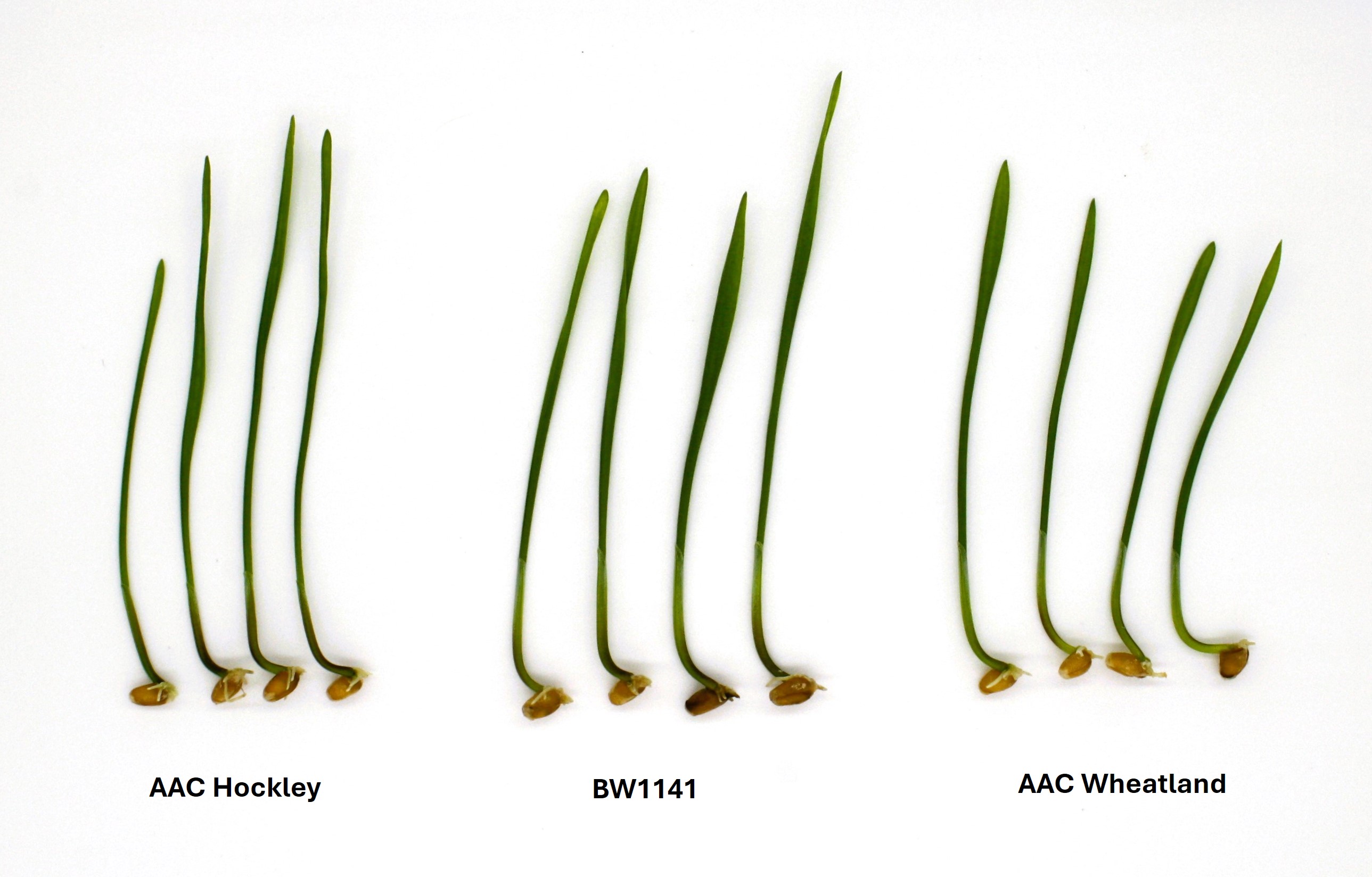
Wheat: ‘AAC Ahead' (center) with reference varieties ‘AAC Hockley' (left) and ‘AAC Wheatland' (right)
- Date modified: